
Iranian Society of Gynecology Oncology (IRSGO)
Document Type : Original Research Article
Authors
Department of Obstetrics and Gynecology, Padjadjaran University, Hasan Sadikin General Hospital Bandung, Bandung, Indonesia
Highlights
✅ In conclusion, our findings demonstrate that coagulopathy is associated with the severity of COVID-19 illness. D-dimer is an important parameter for evaluating the COVID-19 severity in pregnancy. This further could serve as a diagnostic category to differ the severity of COVID-19 in pregnancy.
Keywords
COVID-19 began in China in late 2019, and has become a pandemic (1). Until April 2022, WHO stated there’s 510 million cases of COVID-19 in the world. In Indonesia itself there’s 6 million cases with 156.1000 deaths. Data from Indonesian Society of Obstetrics and Gynecology (POGI) shows in April 2020-2021, 35.099 pregnancy were complicated with COVID-19 with 45% requiring intensive care and 3% mortality rate (2).
Patients with COVID-19 infection have increased risk of thrombosis and blood hypercoagulability (3). Abnormalities of hemostatic factors such as D-dimer at the time of admission were discovered to be associated with disease severity and mortality in Chinese patients with COVID-19 (4). Several studies also highlighted changes in hemocytometry values with accordance to COVID-19 severity (5-7). SARS‐CoV‐2 itself interact with endothelial cells (type II pneumocytes, glomerular capillary loops, and small intestine capillaries) as their target. Furthermore, cell infection and induced inflammation in pericytes and endothelial cells promotes local apoptosis and potent inflammatory cytokines. This causes the neutrophil activation, impaired endothelial function, platelet activation, tissue factor expression, and coagulation induction. The excess of fibrin deposition and fibrinolysis shutdown lead to intravascular thrombosis and, finally, to clinical thromboembolic complications in later cases (8).
Pregnancy is a condition whereas all hemostatic aspect changes to preserve placental function in pregnancy and to prevent excessive bleeding at childbirth. Changes in blood coagulation and fibrinolysis create a state of hypercoagulability. Plasma fibrinolytic activity is reduced during pregnancy, remains low during labor and delivery, and returns to normal early after placental delivery (9). This phenomenon may protect the mother from excessive bleeding but at the same time increase risk for thromboembolism in pregnancy and puerperium.
These unique circumstances provide uncertainties about the diagnostic and prognostic role of hemocytometry values of PT, aPTT, and D-dimer in pregnant patient with COVID-19. This due to the nature of pregnancy itself, whereas changes in blood coagulation and fibrinolysis create a state of hypercoagulability. This study aims to investigate hemostatic changes in pregnant woman with coronavirus disease (COVID-19) and their relationship to disease severity.
This was an observational analytic study with a case control approach. Data was taken from patient's medical record retrospectively. COVID-19 pregnant patient that came to Hasan Sadikin General Hospital from June 2021 until March 2022 was the subject of our research. Ethical clearance was approved by Hasan Sadikin Ethical Committee (LB.02.01/X.6.5/473/2022).
Inclusion criteria for this study are all pregnant COVID-19 patients with Prothrombin time (PT), activated partial thromboplastin time (aPTT), and D-dimer examination. In the exclusion of this study, all pregnant COVID-19 patients without required examination. PT, aPTT, and D-dimer were measured by Stago kits on a Stago automated coagulation analyzer (STA Compact Max®). Data was then analyzed by Kruskal Wallis with IBM SPSS Statistic 26th with α=0.05.
These studies were compromised by 4 groups of different levels of COVID-19 infection. COVID-19 cases were divided according to WHO guidelines based on their disease severity into four grades that include asymptomatic, mild, moderate, and severe disease. Asymptomatic was gathered from COVID-19 screening to all pregnant woman that came to Hasan Sadikin General Hospital, Patients with positive antigen test and no symptoms classified as one. Mild disease classifies as symptomatic patients without evidence of viral pneumonia or hypoxia. Moderate disease classifies as symptomatic COVID-19 patient with clinical signs of pneumonia (fever, cough, dyspnea, fast breathing) but no signs of severe pneumonia, including SpO2 ≥ 90% on room air. The disease is considered severe if clinical symptoms of pneumonia (fever, cough, shortness of breath, and tachypnea) are present with any of the following: respiratory rate >30 breaths/min, oxygen saturation <90% in room air, or signs of acute respiratory distress (10). The figure below demonstrates the methodology of this research.
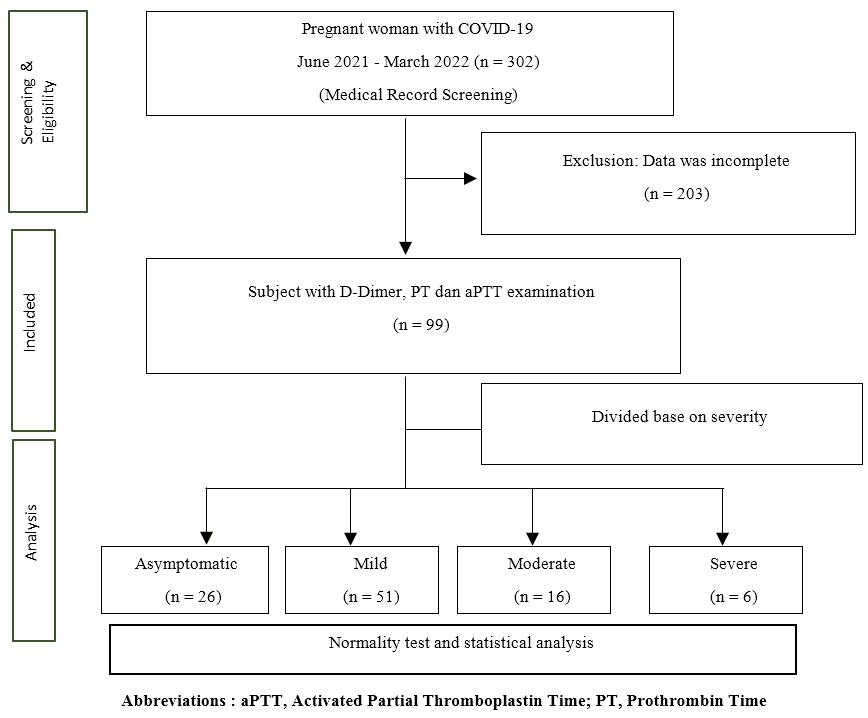
Collected data’s was gathered, sorted, and tested with IBM SPSS 26th Edition. Normalities test was performed and continue with Kruskal Wallis with confidence level 95% (α=0.05).
Results
Table 1 shows subject characteristics, which was seen from age and pregnancy count perspective. In between subject characteristics, the age distribution was quite the same between groups, but the pregnancy count was variable. Normality test was performed on the gathered data and the result was P<0.05. Due to distribution test was significant, the test continues with Kruskal Wallis.
| Characteristic | COVID-19 Severity | ||||
| Asymptomatic (n = 26) |
Mild (n = 51) |
Moderate (n = 16) |
Severe (n = 6) |
||
| 1. Age | |||||
| Mean (SD) Median Range |
27 (5,53) 26 20 - 43 |
29,78 (5,86) 30 18 - 43 |
30,31 (6,15) 27 24-44 |
27,5 (8,69) 24 18-41 |
|
| 2. Pregnancy | |||||
| 1 2 3 >3 |
12 9 4 1 |
14 11 17 9 |
4 4 3 4 |
3 - 1 2 |
|
| Examination | Status COVID-19 | Kruskal Wallis P value |
||||
| Asymptomatic (n = 26) |
Mild (n = 51) |
Moderate (n = 16) |
Severe (n = 6) |
|||
| 1. D-Dimer (mg/L) | p : 0,000** | |||||
| Mean (SD) Median Range |
4,85 (2,35) 1,92 0.62 – 61.23 |
2.86 (0,50) 1,93 0.36 – 21.96 |
5,47 (6,15) 4,06 1,53 - 19,44 |
14,51 (3,77) 17,49 1,92 – 23.20 |
||
| 2. PT (second) | p : 0,365 | |||||
| Mean (SD) Median Range |
11 (0,48) 9,90 9,00 – 19.70 |
10,92 (0,25) 9,90 9,10 – 16.50 |
13,31 (1,43) 10,25 9,3 - 26,30 |
12,28 (3,77) 10,80 9,60 – 18.70 |
||
| 3. aPTT (second) | p : 0,844 | |||||
| Mean (SD) Median Range |
29,04 (1,03) 28,65 21,10 – 47.40 |
29,83 (0,77) 29,10 12,10 – 44.20 |
39,74 (9,56) 27,65 23,30 – 180 |
30,73 (3,03) 29,30 22,6 – 39.8 |
||
Kruskal Wallis test gave significant result on D-Dimer group. This proves there’s a correlation between D-Dimer and COVID-19 severity in pregnancy (p< 0,000). We found different mean value for each group, asymptomatic 4.85 mg/L, mild 2.86 mg/L, moderate 5.47 mg/L and severe 14.51 mg/L. Changes seen after mild group which we have seen increase to 5.47 mg/dL in moderate COVID-19 and furthermore increase in severe become 14.51 mg/L. These results prove there’s a significant change in moderate and severe infection.
Meanwhile, in PT and aPTT shows no different between groups. aPTT median relatively stays at 29 seconds and PT was found at 10 seconds. No significance in these groups could be caused by several factors, such as relatively small sample size in moderate and severe category, or changes in PT and aPTT could be visible after systemic coagulation has been compromised.
Despite changes in blood coagulation and fibrinolysis create a state of hypercoagulability in pregnancy, D-Dimer in pregnancy with COVID-19 prove to be a reliable tool for disease severity. COVID-19 causes a cell infection and induced inflammation in pericytes and endothelial cells promotes local apoptosis and potent inflammatory and cytokines and affects the D-Dimer to the nature of consumptive coagulopathies happens (8). In this research, we found correlation between D-Dimer and COVID-19 severity on pregnancy (P < 0,000). Changes were visible in increase to 5.47 mg/dL in moderate COVID-19 and furthermore increase in severe become 14.51 mg/L. This was also consistent with metanalysis in non-pregnant subject with COVID-19 which stated D-Dimer level increase with progression of COVID-19 (11, 12).
The levels are Previous research that done by Ercan, Özkan (13) shows increase in D-Dimer in normal pregnancy with a range of 0,12-0,31 mg/L with a maximum value of 1,75 at third trimester (13). Using this research as a base for normal range of D-Dimer in pregnancy prove D-Dimer increase in COVID-19 could have proven useful diagnostic tool in assessing severity of COVID-19 in pregnancy.
Meanwhile, in PT and aPTT group, no change avails. PT itself is an examination to hallmark the extrinsic factor and aPTT to hallmark the intrinsic factor. In pregnancy changes occur in intrinsic factor, stable factor and Von Willebrand Factor (14). In this research no changes in both pathways occurs. This could be caused by changes in both pathways, occur when there’s heavy disorder of blood coagulation. Tekle, Gelaw (15) in 2022 founds PT was lower in the mild case compared to moderate and severe case, and showed that PT was significantly higher in severe cases. aPTT was also lower in mild cases compared to moderate and severe cases (15).
As compared with previous research, this study didn’t find any significant increase in aPTT and PT of each level of disease. The increase was lack of consistency in this research, this founding could be caused by formation of blood distribution could be seen clear after systemic manifestation such as disseminated intravascular coagulopathy or could be caused by several factors such as relatively small sample size in moderate and severe category. A metaanalysis by Zhang, Yang (12) found aPTT levels didn’t differ much in different severity levels of COVID-19. Increase was only found on PT and D-Dimer in severe case (12). Bashash, Abolghasemi (11) also stated there’s no significant different of PT and aPTT between severity levels (11). Even estimated pooled means of PT and aPTT were higher in severe cases, their mean values were not significantly higher as compared with non-severe patients
Changes in hematology adaptation in pregnancy includes thrombocyte, intrinsic and extrinsic pathway which are highlighted in Table 1. Thrombocytopenia and relative state of hypercoagulability could blur the results of biomarker compared with normal woman. This change happens to prevent blood loss in labor progress. These same changes also cause relative thrombocytopenia due to blood hemodilution.
Meanwhile, PT and aPTT value don’t differ much in pregnancy compared to normal woman with average levels of 32.5, 30.5, and 30.5 in 1st, 2nd and 3rd trimester respectively (13).
In conclusion, our findings demonstrate that coagulopathy is associated with the severity of COVID-19 illness. D-dimer is an important parameter for evaluating the COVID-19 severity in pregnancy. This further could serve as a diagnostic category to differ the severity of COVID-19 in pregnancy.
Not applicable.
Ethical Approval
Ethical clearance was approved by Hasan Sadikin Ethical Committee (LB.02.01/X.6.5/473/2022).
Availability of data and materials
Applicable; attached alongside this manuscript.
Dataset was also accessible from https://data.mendeley.com/datasets/3w6yrfchmx/1.
Conflict of Interest
The authors declare no conflict of interest.
Authors' Contribution
AS was the consultant for this study and oversee the study, AZS conceived the design in this study, collected the data and done statistical analysis. AZS and AS wrote the draft. AS and AZS agreed the following version of the manuscript for publication.
Funding
None.

| Article View | 1,093 |
| PDF Download | 626 |
