
Iranian Society of Gynecology Oncology (IRSGO)
Document Type : Original Research Article
Author
Department of Obstetric and Gynecological, Medical College, Al-Qadisiyah University, Diwaniya, Iraq
Highlights
✅ Maternal iron reserves are more effectively increased by intravenous ferrous sucrose than by oral ferrous fumarate.
Keywords
The most common nutritional problem and the most prevalent form of anemia in the world is iron deficiency anemia. Anemia during pregnancy affects 25% of women globally. The most common type of anemia is iron deficiency anemia, a disorder in which red blood cells are affected. Iron deficiency symptoms develop over time. Healthcare professionals can treat iron deficiency anemia by identifying and treating its root cause, as well as by giving iron supplements (1). In both rich and developing nations, the prevalence of anemia among expectant mothers, according to the WHO, is 14% in industrialized countries and 51% in poor countries (2). Low consumption of iron and folic acid is among the main reasons for the high incidence of anemia, as well as foods that inhibit iron absorption. These elements, in addition to the limited bioavailability of iron, contribute significantly to the onset of this disease. Due to ascariasis, deficiencies of vitamin B12 and folic acid were also common, along with iron deficiency (2, 3).
Worldwide, 40 % of pregnant women are anemic, and in the USA, about a third of pregnant women have it. Anemia is more likely to occur in pregnant women who give birth prematurely, have high blood pressure, low birth weight, short gestation periods, and cesarean delivery, and females with hemoglobin levels under 7 g/dL significantly increased rates of low birth weight, this suggests that the risk of these negative effects may be proportional to the degree of anemia (3, 4).
Anemia is more common and has more causes in low-income countries. The majority of prenatal anemia research is conducted in areas with poor access to prenatal care, a high incidence of malaria, and malnutrition (5, 6). Maternal anemia has a considerable negative impact on outcomes like low newborn weight, premature delivery, and growth retardation connected to pregnancy, according to the majority of research (7). Anemia hinders the normal growth of the fetus, leading to miscarriages and neonatal deaths. They are associated with higher rates of preeclampsia and preterm birth,28%, and 31%, respectively (8).
Taking oral iron supplements is the most typical method of treating iron deficiency anemia, which are popular among patients due to their effectiveness, safety, and affordability (9).
Poor tolerability and a 40% potential for an adverse effect are the main drawbacks to treatment with oral iron in its original form (10). Constipation, diarrhea, upset stomach, and gastrointestinal symptoms are frequent adverse effects (11).
The safe and commonly used substance ferrous sucrose has garnered a lot of attention in the fight against iron deficiency anemia, is a commonly used and safe drug, and has become a chief concern in preventing iron deficiency (12).
The Current Study aims to evaluate the effectiveness of orally ferrous fumarate and IV iron sucrose in treating iron deficiency anemia during pregnancy.
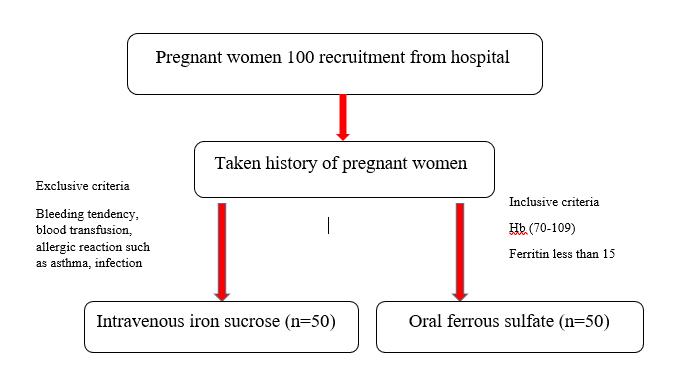
This study is a prospective randomized clinical trial. All participants in this study gave their written, informed permission before taking in the obstetric unit of Al-diwaniya of Maternity and Children Hospital, which was conducted from October 2022 to July 2023. Ethical committee clearance was gained from the hospital's ethical committee. One hundred pregnant women selected from the hospital were between 14 and 34 gestational weeks. After a full history and physical examination, laboratory investigations achieved were hemoglobin level, packed cell volume (PCV), red blood cell count, red blood cell indices, reticulocyte count, and peripheral smear to exclude other types of anemia. Iron deficiency anemia was established by a serum iron profile study consisting of serum ferritin, serum iron, and total iron binding capacity. The investigations were repeated after 4 weeks. Inclusion criteria include a ferritin level is less than 15 ng/ml and a Hb level between 70-10.9g/L. In other words, the exclusion criteria were having a history of blood transfusion predisposition during the past four months, having a history of bleeding, allergic reactions, or acute inflammatory conditions. Formerly, patients were allocated or divided into two groups as follows.
Group I – (Oral iron therapy), and Group II- (Intravenous iron therapy) the selection by randomly method. In each group, 50 patients were assessed. For four weeks, the patients in the oral group assumed two ferrous fumarate pills, each of which enclosed 100 mg of elemental iron. This therapy included a daily dosage of 5 milligrams of folic acid. To make sure that women were taking the recommended dosage of tablets, they were asked to carry back unfilled packets and to describe how many they had taken the tablets. Patients were asked about adverse effects at each appointment. The dosage of iron sucrose to be given to the intravenous group was determined after the calculation of the dose according to the Equation below (9).
Total dose required = weight in kg × (target Hb in g/L – Actual Hb in g/L) × 0.24 + 500 mg.
This iron sucrose complex dosage was assumed intravenously over a 20 to 30-minute interval, once a day, in a solution that contained 200 mg (supplemental iron) and 100 cc (0.9% NaCl) isotonic saline. There was no test dosage supplied because it may give a false reassurance, and it was given by a staff trained in the obstetric unit of the hospital to evaluate and manage anaphylactic reaction if it occurs. The entire required dose of iron sucrose is divided and given every two days. This treatment should be added with 5 milligrams of oral folic acid every day for four weeks to counteract the effects of this deficiency on outcomes and prevent subsequent deficiency of folic acid. Throughout the four weeks of the trial, further oral iron delivery was proscribed. Figure (1) shows the protocol used in the study.
Statically Analysis
The data will be analyzed using the SPSS statistical program (SPSS) 23 version (IBM, USA). Also, the data will be described using descriptive statistics, such as standard deviation, frequency, proportion, and mean. paired t-test used before and after treatment Also, independent t-tests and chi-square tests will be used to compare between two groups oral & and injection, in postoperative complications (P-value) groups is significantly less than 0.05, and highly significance is less than 0.001 using, chi-square test to compare between percentages.
Results
Demographic Result
One hundred patients enrolled in the current study with their age as demonstrated in figure (1).
In group I, most patients the aged 27-30yr (54%) and in group II most of them were aged of 22-27yr (44%)
The BMI in (group 1) most of the patients 70% are overweight while in group 2 (66%) are overweight. multigravida were 56% in group 1 and (54%) in group 2 these data are revealed in Table (1).
Table 1. Demonstrate Demographic features in Current Study
Parameter (n %) |
Group I oral iron n=50 |
Group II Intravenous iron n=50 |
|
| Age (years) | 18 -21 | 17(34%) | 11(22%) |
| 22-26 | 16(32%) | 22(44%) | |
| 27-30 | 27(54%) | 17(34%) | |
| BMI (kg/m2) | Underweight<19 | 2(44%) | 6(12%) |
| Normal =19-23 | 19(38%) | 11(22%) | |
| Overweight >24 | 35(70%) | 33(66%) | |
| Parity | Primi | 22(44%) | 23(46%) |
| Multi | 28(56%) | 27(54%) | |
| Gestational age week interval (week) | 14-20 | 16(32%) | 14(28%) |
| 20-29 | 17(34%) | 22(44%) | |
| 30-34 | 17(34%) | 14(28%) | |
Assessment of Hemoglobin Level
As displayed in Table 2 and Table 3, in comparison to hemoglobin level produces substantial variation between pre- and post-treatment (P=0.001) While comparison before treatment of two groups I and II shows no significant differences (P=0.376). When comparing post-treatment of two groups, shows a significant difference in each group (P= 0.001). The current study demonstrated the percentage change % in hemoglobin levels between groups.
Table 2. Defining the hemoglobin level before and after treatment in groups I (oral iron) and II (intravenous iron)
| P –value | Hb level after Treatment (g/l) | Hb level before Treatment (g/l) | Group | number |
0.001 |
9.138± 1.094 (B, a) |
8.426 ± 1.020 (A, a) |
Group I | N=50 |
0.001 |
10.68± 0.9196 (B, b) |
8.360 ±1.079 (A, a) |
Group II | N=50 |
| 0.001 | 0.376 | P-value |
Table 3. The hemoglobin level percentage change before and after therapy in Group I (orally) and Group II (intravenous)
| Difference | Percentage change % increase | Group | No. |
| 0.712 | 8.45% | Group I | |
| 2.32 | 27.751% | Group II | |
| 0.001 | p-value | ||
Evaluation of Serum Ferritin Levels
As presented in Table 4 & Table 5, in comparison, Serum Ferritin Level harvest significant difference pre- and post-treatment (P=0.001). The comparison before the treatment of the two groups showed non-significant differences (P=0.08). When comparing post-treatment, both groups showed a significant difference in each group (P= 0.001). The current study demonstrated the percentage change % in hemoglobin levels between groups.
Table 4. The serum ferritin levels in Group I (oral iron) and Group II before and after treatment (Intravenous iron)
| P –value | Ferritin level after treatment | Ferritin level before treatment | Group | Number |
| 0.001 | 76.74 ± 15.18 | 9.240 ± 0.9596 | Group I | |
| 0.001 | 180.3 ± 45.82 | 10.33 ± 1.038 | Group II | |
| 0.001 | 0.08 | P-value |
Table 5. the difference in blood ferritin levels between group I (oral) and group II (intravenous iron) before and after therapy, expressed as a percentage.
| Difference | Percentage change % increase | Group | No. |
| 67.5 | 730.52% | Group I | |
| 169.97 | 1645.40 % | Group II | |
| 0.001 | p-value | ||
Percentage change % = (initial –final /initial) *100, chi-square test
Discussion
Considering its possible effects, iron deficiency anemia during pregnancy warrants careful attention. The physiological hemodilution that occurs during pregnancy, which peaks between 20 and 24 weeks of gestation, causes variations in the hemoglobin level throughout the trimesters (13). In this study, the patients who received the intravenous iron therapy had a higher rate of response in replenishing iron stores and increasing hemoglobin levels than those patients who received the oral iron. No adverse effects are noted for both groups, except minor gastrointestinal symptoms in the oral iron group.
A definitive and comparable increase in hemoglobin is performed and S. ferritin showed a statistically significant increase after parenteral iron treatment in comparison to oral treatment in agreement with Al, Unlubilgin (14).
A report completed by Radhika et al. presented that oral was supplemented with significant G.I.T side effects and non-compliance to oral treatment, which led to failure of treatment strategies (15).
Additionally, a Cochrane study discovered that intravenous iron therapies result in more quickly replenishing the body's iron stores than oral iron (16). For the management of anemia during pregnancy, particularly in those who are malnourished and frequently have numerous pregnancies, parenteral iron therapy causes a considerably larger rise in serum ferritin than oral administration. For future pregnancies as well as breastfeeding, enough iron reserves are crucial.
Bhavi and Jaju conducted research in which they employed ferrous fumarate oral iron at a dosage of 200 mg per day to treat IDA in pregnant women. They reported that pregnant patients taking oral therapy complied well. However, he believed that gastrointestinal problems were dose-related because they frequently occurred with higher dosages and were also impacted by the formulation of oral iron (12).
Our research revealed that oral drugs reported during pregnancy have less effect than the parental group, some pregnant women experienced unnecessary complaints including nausea for a brief period.
I.V. therapy is a safe choice for treating iron deficiency anemia since it minimizes the requirement for blood transfusions. The relatively unintended negative effects of iron deficiency anemia treatment in this way include anaphylactic shock, fever, hemolytic reactions, infection (including parasitic bacterial and protozoan infections, HIV, hepatitis B and C and allogeneic immunization, and host disease-versus-graft (17).
Another research that agreed with our current study was conducted by Kriplani A. et al. in which pregnant women were enrolled for 200 mg twice-weekly I.V. iron sucrose complex dosages. No significant side effects or allergy or anaphylactic reaction occurred (18).
This study discovered that parenteral injection of iron sucrose replenishes iron stores and raises hemoglobin more successfully than orally taken ferrous fumarate for the correction of iron deficiency anemia in pregnant women. Oral preparations of iron are efficient, safe, and inexpensive, although noncompliance, achlorhydria, inflammatory bowel disorders, or undiagnosed bleeding may cause it to fail in its effectiveness, in our study there is only 12% of the oral iron group of patients developed minor gastrointestinal symptoms like nausea and mild epigastric pain and these symptoms are overcome by taking the drug two hours after meal. On the other hand, the intravenous iron therapy group of patients didn’t report any allergic reactions or adverse effects. In other studies, life-dangers of allergic reactions, such as unexpected cardiac arrest and respiratory failure have happened in 0.1 percentage points to two percentage points of cases of people using this drug. 30% of individuals experienced negative side effects, such as fever, Arthritis pain, and hives. It is not recommended for those suffering from rheumatoid arthritis due to the bouts of arthritis associated with it. Even in those with rheumatoid arthritis, iron sucrose appears to be effective and has fewer adverse effects (19). Oral iron therapy is cheaper than intravenous iron sucrose, which is considered an advantage regarding the cost-effectiveness for the patients.
Conclusion
Iron deficiency anemia during pregnancy can be safely and effectively treated with IV sucrose complex (ISC). IV iron sucrose is the most effective iron treatment utilized in obstetrics since it is secure, efficient, and simple to apply.
Acknowledgments
None.
Funding Source
None.
Conflicts of Interest
The authors declared no conflict of interest.

| Article View | 5,805 |
| PDF Download | 1,401 |
