
Iranian Society of Gynecology Oncology (IRSGO)
Document Type : Original Research Article
Authors
Department of Obstetrics and Gynecology, College of Medicine, University of Al-Qadisiyah, Al-Diwaniyah Province, Iraq
Highlights
✅ Serum anti-Mullerian hormone accurately predicts pregnancy success in PCOS women taking clomiphene citrate to induce ovulation.
Keywords
Poly cystic ovarian syndrome (PCOS) is the most frequent endocrine disorder affecting women during reproductive age (1-3). The disease is characterized by increased androgen level, which is manifested clinically as hirsutism and anovulation because of the associated hormonal disturbances (4, 5). Hyperandrogenemia can be proven biochemically via assessing serum testosterone level (6, 7). The diagnosis of the condition resides on demonstration of Rotterdam criteria including clinical and biochemical evidence of hyperandrogenemia, anovulation and polycystic ovarian morphology (8, 9).
The disease is common in our community and is responsible for several medical and obstetric and gynecological consequences (10, 11). Central obesity is frequently seen in those women with associated insulin resistance and dyslipidemia (12). The polycystic ovarian syndrome is an important cause of infertility in routine obstetric practice and seeking medical advice to have a baby is a common cause to diagnose Iraqi women with PCOS (13, 14). PCOS is the first etiology of infertility that is anovulatory nowadays and infertility is found in 70 to 80% of afflicted females (15). PCOS is the first reason behind women's infertility, but the definite diagnosis must be labeled after exclusion of other causes of sub-fertility (16).
A useful test for judging infertility is the hormone anti-Mullerian (AMH) test. It helps in estimating the ovarian reserve and is produced by the granulosa cells of follicles that are early. Its levels remain constant throughout the menstrual cycle due to its gonadotrophin-independent production (17). Because there are higher count of tiny antral and preantral follicles, women having PCOS possess AMH amounts that are 2 to 3-fold greater than those of females without the disease. The severity of PCOS appears to be linked with the elevated AMH level (18).
For PCOS-afflicted women, lifestyle modifications are the first line of treatment. Smoking should always be stopped, and exercise should be encouraged. In women who are overweight or obese, weight loss is advised (19). The standard treatment for PCOS-related infertility in women is still clomiphene citrate (CC) (20). Through the negative feedback mechanism, CC, an anti-estrogen treatment, stimulates the growth of follicles by blocking estrogen receptors in the hypothalamus (21, 22). To determine the day of ovulation and to avoid multiple pregnancies (11% risk), the administration of CC must be followed (by ultrasound and endocrine blood sample). Ultrasound examination is used as a monitoring tool, for measurements of follicular growth and endometrial thickness (23-26).
Sufficient controversy exists in the available published articles that justify the planning and conduction of the current project with an aim to assess the value of anti-Mullerian hormone (AMH) as an anticipator of ovary response to clomiphene citrate in patients with “polycystic ovary syndrome (PCOS)”.
The present cross-sectional study enrolled 50 women who were diagnosed with polycystic ovarian syndrome based on Rotterdam criteria by 2 gynecology specialists. The study was done in the department of obstetrics and gynecology in the “Maternity and Pediatric Teaching Hospital” at Diwaniyah Province, Iraq during the period from 1st of August 2022 through 15th of May 2023. Women with other associated comorbidities such as diabetes mellitus or hypertension were excluded from the study. Those women were principally seeking medical advice for being infertile and were receiving clomiphene citrate for induction of ovulation. Patients were divided into 2 categories based on the results of hCG urinary and blood tests as positive biochemical pregnancy and negative biochemical pregnancy.
The main included variables were age of women, their “body mass index (BMI)” which “was calculated as (weight in kg divided by height in meter squared)” (27), serum follicle stimulating hormone (FSH) level and anti-Mullerian hormone (AMH) level.
All participants were asked to fill a written consent following full illustration of the goal and the procedure of the current study, and the project was approved by the committee of ethical consideration of the College of Medicine / Al-Qadisiyah University.
Statistical analysis was done using the software program “statistical package for social sciences” (SPSS) (version 16.0, USA, IBM, Chicago). Numeric variables were shown in the form of range, standard deviation, and average. Qualitative variables were shown in the form of percentage and count. The independent sample t-test was used to compare the mean between the interventional group and the placebo group. “Receiver operating characteristic (ROC) curve” analysis was carried out to find the best AMH cutoff value that can predict positive biochemical pregnancy. The level of significance was considered when the p-value equals or less than 0.05.
The frequency distribution of participating women according to the results of pregnancy biochemical test is shown in Figure 1; the study included 16 (32 %) women with positive pregnancy test and 34 (68 %) women with negative pregnancy test.
Demographic characteristics of women enrolled in the present study are shown in Table 1. The mean age of all enrolled women was 25.76±4.54 years, and we did not detect significant variation in average age between pregnant and non-pregnant women (P = 0.801). The mean BMI of all enrolled women was 23.72±2.91 kg/m2, and we did not detect significant variation in mean BMI between pregnant and non-pregnant women (P = 0.381).
Comparison of serum follicle stimulating hormone (FSH) and serum anti-Mullerian hormone (AMH) levels between women with positive pregnancy and women with negative pregnancy is shown in Table 2. The mean FSH of all enrolled women was 5.19±1.14 IU/L, and we did not detect significant variation in mean FSH between pregnant and non-pregnant women (P = 0.849). The mean AMH of all enrolled women was 6.97±2.88 ng/ml and variation that is statistically significant was deselected in average AMH between pregnant and non-pregnant women (P< 0.001); the level being lower in women with pregnancy compared to women with no pregnancy.
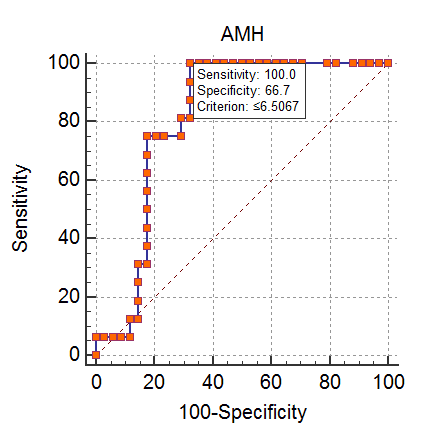
“Receiver operating characteristic (ROC) curve” analysis was carried out to find the best AMH cutoff level that can predict positive biochemical pregnancy, and the results were shown in Figure 2 and Table 3. The cutoff value was ≤6.5 ng/ml with 100 % sensitivity rate, 67.7 % specificity rate and 80.9 % accuracy rate.
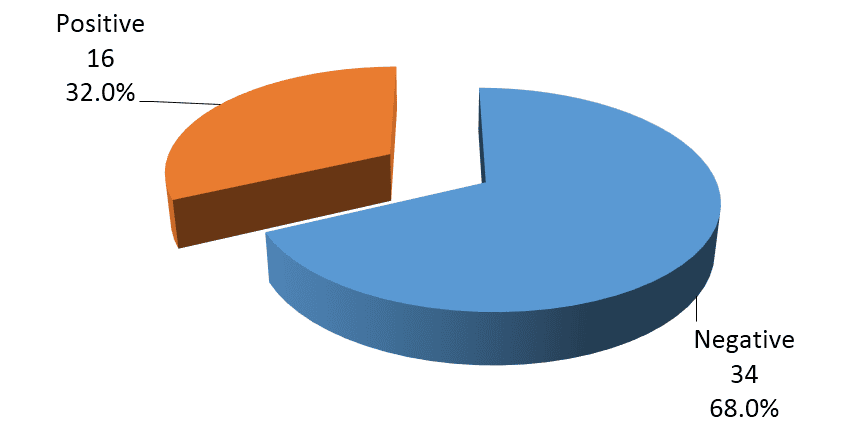
Figure 1. Pie chart to show the proportions of participating women according to the results of pregnancy biochemical test.
Table 1. Demographic characteristics of women enrolled in the present study
| Characteristic | Total n = 50 |
Positive n = 16 |
Negative n = 34 |
p |
| Age (years) | ||||
| Mean ±SD | 25.76±4.54 | 26.00±4.63 | 25.65±4.57 | 0.801 I NS |
| Range | 18 -34 | 19 -33 | 18 -34 | |
| BMI (kg/m2) | ||||
| Mean ±SD | 23.72±2.91 | 23.19±2.07 | 23.97±3.23 | 0.381 I NS |
| Range | 19 -32 | 19 -27 | 19 -32 | |
| Normal weight † | 34 (68.0 %) | 12 (75.0 %) | 22 (64.7 %) | --- |
| Overweight | 13 (26.0 %) | 4 (25.0 %) | 9 (26.5 %) | |
| Obese | 3 (6.0 %) | 0 (0.0 %) | 3 (8.8 %) |
| Characteristic | Result |
| Cutoff value | ≤6.5 ng/ml |
| AUC | 0.809 |
| 95 % CI | 0.673 to 0.906 |
| P-value | < 0.001 *** |
| Sensitivity % | 100.0 |
| Specificity % | 67.7 |
| Accuracy % | 80.9 |
The present study was done to explore how valid measuring serum AMH in predicting positive pregnancy outcome in women with PCOS and receiving clomiphene citrate for ovulation induction. We found that serum AMH was significantly higher in women succeeded in getting pregnant when compared to that of non-pregnant women, and that a cutoff value to good level of accuracy was obtained. Sachdeva, Gainder (28) performed a study to figure out the value of ultrasound features, metabolic, clinical, and hormonal characteristics and of patients with PCOS in anticipating the response to clomiphene citrate in management of subfertility and found that serum AMH was significantly lower in clomiphene sensitive group in comparison with clomiphene resistant group (28). This finding indeed came in line with our observation. In addition, the article of Xi, Yang (29) reported AMH to be a useful predictor of no response to clomiphene (29). Furthermore, Gülşen, Ulu (30) carried out a study to evaluate the value of AMH in anticipating to clomiphene citrate in patients with PCOS, and they found that serum concentration of AMH was observed to behave as a sensitive predictor of resistance to clomiphene citrate with a specificity of 89% and a sensitivity of 66%. These findings are also supportive of our observations (30). Moreover, Vagios et al. conducted a study to find out whether AMH can anticipate ovulation induction response using clomiphene citrate in patients with PCOS, and they found that in total population of study, cycles with the characteristic of response to treatment had significantly lower AMH levels when contrasted to those failed to response (31). Gynecologists would have more time to switch from CC to alternative therapy modalities, like gonadotropin or laparoscopy, if the rate of success in individuals can be anticipated sooner (32, 33). Age, hyperandrogenemia and BMI can be used as indicators of ovulation response with CC therapy (34). Additional variables that can predict the treatment response of CC include ovarian volume and menstrual state (33). A possible indicator of CC resistance is the proportion of plasma glucose to insulin level at fasting (35). Anti-Mullerian hormone (AMH) is thought to have an impact on CC resistance because it is a key regulator in the ovary (30). The distinct patterns of expression in the ovary suggest that AMH may be involved in the growth and maturation of follicles (36). AMH is a follicle-stimulating hormone (FSH) inhibitor, which is primarily formed by small antral and preantral follicles via their granulosa cells. It also reduces the effect of FSH-guided rise in aromatase function at the time of early follicle maturation (30). AMH has demonstrated a good link with ovarian sensitivity to FSH (30), and it also plays a significant function in the ovarian follicular milieu related to ovarian folliculogenesis (37). A study that showed that low continuous dose of inject able recombinant FSH dramatically reduced AMH amount in follicles supported the involvement of AMH in follicle development. The follicles' inhibitory mechanism was disrupted by a drop in AMH level, allowing them to grow into mature follicles (38). According to earlier research, AMH may be helpful in predicting the ovarian response to CC in obese women who are anovulating (39).
Evaluating the hormone anti-Mullerian in serum is a highly accurate measure to predict positive pregnancy outcome in PCOS women receiving clomiphene citrate for induction of ovulation.
Deep thanks and appreciation to all women with polycystic ovarian syndrome participated in the present study.
Authors' Contribution
Study concept and design: BN and SN; Drafting of the manuscript: BN and SN; Critical revision of the manuscript: BN and MA; Statistical analysis: SN. All the authors have given final approval of the version to be published.
The authors declare no conflict of interest.

| Article View | 1,244 |
| PDF Download | 618 |
