
Iranian Society of Gynecology Oncology (IRSGO)
Document Type : Original Research Article
Authors
1 Department of Obstetrics and Gynecology, Arash Women’s Hospital, Tehran University of Medical Sciences, Tehran, Iran
2 Department of Gynecology Oncology, Imam Khomeini Hospital Complex, Vali-E-Asr Hospital, Tehran University of Medical Sciences, Tehran, Iran
3 Vali-E-Asr Reproductive Health Research Center, Family Health Research Institute, Imam Khomeini Hospital Complex, Tehran University of Medical Sciences, Tehran, Iran
Highlights
✅ CIN cases with age higher than 40 years need to have more caution and tight follow-up visit after conization.
Keywords
Cervical cancer is one of the most prevalent cancers of women worldwide, which can cause a higher rate of mortality (1, 2). The concept of pre-invasive cervical intraepithelial neoplasia (CIN) is cancerous changes in squamous cervix cells that are limited to the epithelium, and basal layer. If CIN is not treated, it progresses towards cancer and can turn into cervical cancer (3).
To prevent CIN progression, the precancerous lesions are removed through conization. This operation is mostly performed by Cold knife conization (CKC) or Loop electrosurgical excision (LEEP). These methods are both diagnostic and treatment methods. It should be tried to collect the sample to include all affected areas of both ecto-cervix and endo-cervix (4).
HPV (Human papillomavirus) can lead to malignancy and abnormalities of the cervix. HPV can lead to dysplasia of the cervix (which is known as cervical intraepithelial neoplasia [CIN]) which can lead to cervical malignancy. Even though some cases that have HPV infection never develop malignancies and CIN, most of the cases are at CIN risk (5).
In addition, female CIN cases with appropriate treatments and follow-up are at lower risk of developing cervical malignancies. Moreover, the recurrence of CIN is a risk for cervical malignancies. In addition, retreatment correlates with fertility status in cases that wish to maintain the potential reproductive status (6).
Because of the importance of risk factor detection for recurrence, different research has been conducted to evaluate risk factors associated with the recurrence of CIN. Immunosuppression, HPV persistence, and smoking are the main-related risk factors of CIN recurrence. However, age as a basic factor may be a main factor related to CIN recurrence (2, 7). Therefore, our study aimed to detect the potential role of women's age in CIN recurrence.
This cross-sectional study was conducted on 329 patients who underwent conization in the gynecology-oncology clinics of Arash and Imam Khomeini hospitals affiliated with Tehran University of Medical Sciences between March 2016 and March 2021.
The women aged at least 18 years old with conization indications were enrolled in the study. Patients with invasive cervical cancer were excluded.
All patients were followed after treatment for at least 24 months. The study population was visited every six months for two years after their first conization to detect any disease recurrence. The recurrence criteria were positive colposcopy biopsies. Detection of CIN II or III was shown in biopsies.
The following data were recorded for both groups: maternal age, body mass index (BMI), menopausal status, contraception method, and the first intercourse age, sexual partner number, smoking, and underlying disease status.
The data were obtained based on the mentioned checklist, and then the data were entered into SPSS statistical software (version 23, IBM, USA). The normality of the data was evaluated by Kolmogorov-Smirnov test. To analyze the data, independent t-test and paired t-test were used, and if the assumption of normality of the data was not established, equivalent non-parametric tests were done. All analyses were performed using SPSS version 23 software at a significant level (P<0.05).
Results
Totally, 329 cases were enrolled in the study. Most women were in their thirties. Eighty-one cases (24.6%) were nulliparous, 301 cases (91.5%) were in the premenopausal period, and others were in the postmenopausal period. The only diagnosis in the 10s and commonest pathology in the 20s, 40s, and 50s was LSIL, in addition, the most common cytological diagnosis was NILM in 30s patients and ASCH in 60s cases (Figure. 1).
CIN recurrence was about 10.0% (32 cases). The histopathological diagnosis included CIN III in 24 cases (72.7 %) and the other was CIN II. Pathological variables of evaluated cases based on the age categories were analyzed. The CIN recurrence rate was 8.9% in women younger than 30, 10.2% in 30-40, 11.3% in 40-50, and 5.6% in 50–60 decades. There was no significant (P-value=0.802) difference in recurrence rate among age groups (Figure. 2).
There was a significant (p-value=0.023) difference in the frequency of endocervical involvement regarding age category, women aged 40 to 50 had the most frequent marginal involvement with 26.8%, while there was no significant (P-value=0.802) difference in frequency of marginal involvement regards age category (Table 1).
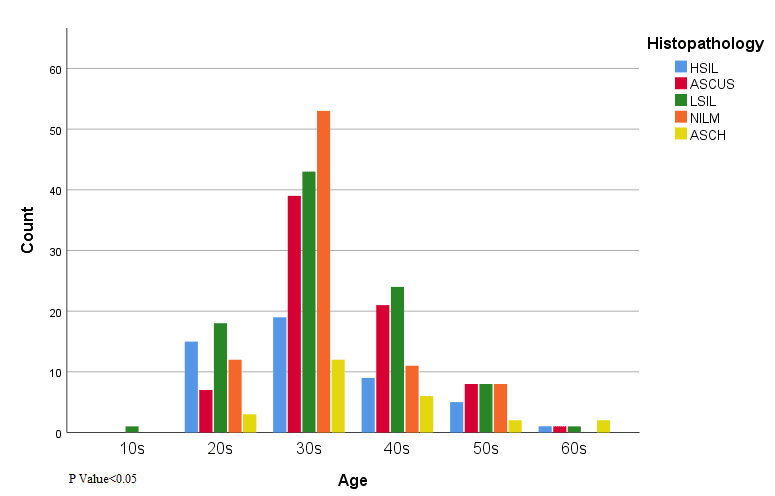
Figure 1. Cytological results in pre-conization pap-smear in different age-groups
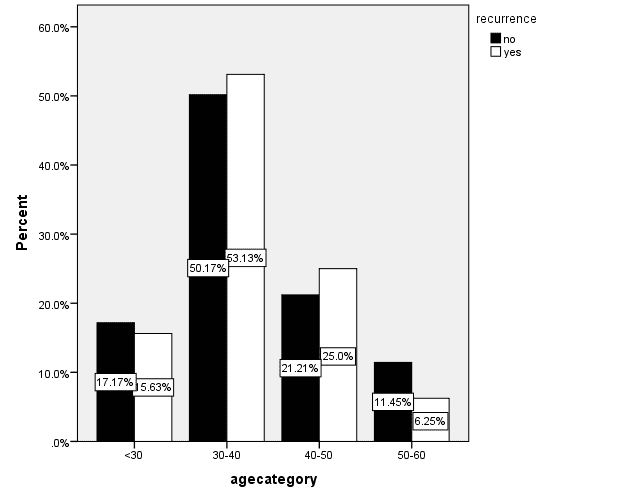
Figure 2. Cervical intraepithelial neoplasia recurrence rate based on different age groupsTable 1. Endocervical and Margin involvement frequency in different age category
Table 1. Endocervical and Margin involvement frequency in different age category
| Age category |
Endocervical involvement |
Margin involvement |
||
| Yes | No | Yes | No | |
| <30 | 9 (16.1) | 47 (83.9) | 7 (12.5) | 49 (87.5) |
| 30-40 | 19 (11.4) | 147 (88.6) | 16 (9.6) | 150 (90.4) |
| 40-50 | 19 (26.8) | 52 (73.2) | 10 (14.1) | 61 (85.9) |
| 50-60 | 4 (11.1) | 32 (88.9) | 2 (5.6) | 34 (94.4) |
| P-value | 0.023 | 0.523 | ||
Discussion
The CIN II and III incidence is increasing in Iran, with the highest prevalence rate in 30 to 45 years of age (8). However, the recurrence rate of CIN in Iran and its relation to age are unobvious. In the present study, management after conization for cases older than 40 years of age needs to consider the recurrence. Even though CIN III was the most common histological detection in any age, also the margin involvement rate was enhanced in older cases. In particular, the detection was statistically more in female cases aged between 30 and 40 years of age. Biopsy with colposcopy is the best method for its precursors and detection of cervical cancer (9).
Moreover, cervical region atrophy, decreased exfoliation of cells in post-menopausal cases and the squamocolumnar junction retraction may lead to a discrepancy between post-operative conization findings and preoperative biopsy in addition to unsatisfactory colposcopic biopsy (10).
Previous researchers have shown that the status of the surgical margin as the most important risk factor for recurrence in cases with CIN after conization should be considered (3, 4).
In concordance with other research in this field, our information corroborates that a positive margin is the most important prognosticator of the recurrence of CIN cases after conization. So, close follow-up is necessary for early diagnosis of CIN recurrence with positive margins. Arbyn, Redman (6) mentioned that high-risk human papillomavirus post-treatment prognosticator recurrent or residual CIN2+ more accurately than surgical condition (6).
In Iran HPV-11 and HPV-6 were the most common low-risk genotypes of HPV in addition HPV-52 and HPV-16 were the most common genotypes of high-risk HPV, respectively (11). The previous research has mentioned that high-risk HPV presence was higher in younger cases before conization and was more common in these cases post-conization. In addition, pre- and post-conization HR-HPV (high-risk HPV) were affected by the age of the patient. So, HR-HPV distribution based on age is a risk factor (2, 12, 13), however we did not evaluate the effect of HR-HPV.
In addition, another study observed that female cases more than 50 years of age with CIN III identified a statistical decrease in lesions, including high-grade cytological changes high-grade colposcopic impression, and HPV16 (14). So, pathological methods showed more reliable and precise data than other factors, and this method could be particularly considered for diagnostic aims in female cases aged more than 50 years (5, 7, 15)
In addition to the effect of women s age on CIN recurrence rate, it has significantly influence on HPV clearance (16).
Conclusion
Our study showed that recurrence and positive surgical margins were more common in 30 to 40 years of age. CIN cases with age higher than 40 years need to have more caution and tight follow-up visit after conization.
Acknowledgments
This investigation was based on the thesis submitted by the (Nooshan Tajik) to the Tehran University of Medical Sciences.
Ethical Statement
This study was approved by the ethics committee of Tehran University of Medical Sciences (Code: IR.TUMS.MEDICINE.REC.1400.1041) and performed after submission of written signed informed consent form by each patient.
Conflicts of Interest
There are no conflicts of interest.
Funding
This study was supported by Tehran University of Medical Science.

| Article View | 1,568 |
| PDF Download | 938 |
