
Iranian Society of Gynecology Oncology (IRSGO)
Document Type : Original Research Article
Authors
1 Department of Applied Embryology, Al-Nahrian University, Baghdad, Iraq
2 Department of Anesthesia, The Higher Institute of Infertility and Assisted Reproductive Techniques, Al-Nahrain University, Baghdad, Iraq
3 Department of Obstetrics and Gynecology, Faculty of Medicine, Mansoura University, Mansoura, Egypt
4 Department of Experimental Embryology Zoology, Faculty of Science, Mansoura University, Mansoura, Egypt
Highlights
✅ The associations of LH and FSH with anesthesia are different depending on the type of anesthetic drugs.
Keywords
Infertility is one of the principal problems couples have in their early years of marriage. Primary infertility is a prevalent reproductive issue that affects approximately 10-15% of couples worldwide (1, 2). In case of infertility and menopausal, as a result of a decline in ovarian function, the pituitary produces more luteinizing hormone (LH) and follicle-stimulating hormone (FSH) to make up for the dropping amounts of estradiol. Considering differences in the FSH trajectory's rates of change, accelerations, and decelerations (3). The primary barrier to the reproductive problem of infertility has always been therapy. The management of infertility includes assisted reproductive technologies (ARTs), fertility drugs, medical and/or surgical therapy of the underlying cause (4, 5). Infertility is treated by assisted reproductive technology (ART), particularly in vitro fertilization (IVF).
The effectiveness of in vitro fertilization (IVF) is determined by the following processes: controlled ovarian stimulation (COS), oocyte pick-up (OPU), fertilization, embryo transfer (ET), and implantation. The outcome of these phases is what determines if IVF is successful. The OPU method is required because the quality of the oocytes influences the quality of the embryos, the process of fertilization, and the implant ability (6-8). The OPU therapy is a painful procedure that requires sedation, anesthetic, or analgesia alone, despite being a minimally invasive procedure (9, 10).
Neural anesthesia (spinal or epidural), general anesthesia (GA), local block techniques (paracervical or paraovarian block), conscious sedation, alternative techniques like electro acupuncture, and any combination of the aforementioned are among the many anesthetic techniques designated for oocyte recovery (11-13).
The µ-opioid receptor agonists Fentanyl and Remifentanil have been promoted by a number of writers due to their quick acting time (8–10 minutes), quick onset, quick clearance and elimination rate without drug accretion, quick recovery time, and enhanced reproductive success following oocyte retrieval (11, 14). Pruritus, nausea, vomiting, bradycardia, hypotension, and respiratory damage are the side effects (15). There are few studies examining hormone fluctuations after general anesthetic procedures in connection to the menstrual cycle. Information on hormone behavior during midcycle anesthesia is particularly lacking.
This study was carried out prospectively in the infertility department of the "High Institute of Infertility Diagnosis and Assisted Reproductive Technologies/Reproductive Physiology/Al-Nahrain University/Baghdad/Iraq." The Mansoura University in Egypt's Faculty of Science's ethical committee approved the study. In the trial, ninety infertile women with a range of infertility-related conditions received intracytoplasmic sperm injections (ICSI). The women ranged in age from 25 to 45 years old. The investigation's original deadline of December 2022 has been extended to December 2023. Depending on the anesthetic regimen used, patients having oocyte retrieval under general anesthesia were divided into two groups. Participants were given midazolam, propofol, and fentanyl in one group and remifentanil, midazolam, and propofol in the other.
All participants successfully completed the standard ICSI procedure, which consists of controlled ovarian stimulation, ovulation induction, oocyte harvesting under general anesthesia, clinical assessment (history, examination, and investigation), and other steps. Furthermore, serum sample collection was done both before and after anesthesia for the purpose of later assessing the concentration of hormone levels (follicular stimulating hormone (FSH), luteal hormone (LH)) Sperm processing has already occurred following oocyte denudation. In a private laboratory, serum was collected both before and after anesthesia using enzyme-linked immunosorbent tests (ELISA).
Results
The vital signs were compared between two groups of patients before anesthesia; accordingly there was significantly higher systolic blood pressure in remifentanil group (p=0.30); however there were no significant differences in diastolic blood pressure (p=0.767) and heart rates (p=0.512) as presented in (Table 1).The comparison of vital signs pre and post both fentanyl and remifentanil anesthesia was demonstrated in (Table2), (Figure 1 and 2), the results showed significantly lowering of both diastolic blood pressure after fentanyl and systolic blood pressure after remifentanil anesthesia (p <0.001), on the contrary, heart rates were significantly higher after both fentanyl and remifentanil anesthesia (p <0.001). In addition, there was insignificantly lower systolic (p=0.059) and diastolic blood pressure (p=0.110) after fentanyl and remifentanil anesthesia, respectively. Compare the hormonal levels before and after fentanyl anesthesia, according to the results, there were significantly higher LH levels after fentanyl anesthesia (60.57 ± 3.61 vs. 57.77 ± 2.75; p = 0.014); however, there were insignificantly higher FSH (p = 0.481) levels post fentanyl anesthesia (Table 3). There were also significantly higher LH levels after remifentanil anesthesia (73.97 ± 3.67 vs. 66.57 ± 3.80; p = 0.046); in addition, there were insignificantly higher FSH levels (52.93 ± 4.35 vs. 47.57 ± 3.45; p = 0.383) (16) levels after remifentanil anesthesia (Table 4).
| Parameters | Fentanyl group n=30 (Mean ± SD) |
Remifentanil group n=30 (Mean ± SD) |
p value |
| Systolic BP (mmHg) | 122.83 ± 12.41 | 131.00 ± 15.81 | 0.030 Ŧ S |
| Diastolic BP (mmHg) | 75.53 ± 12.86 | 76.50 ± 12.34 | 0.767 Ŧ NS |
| Heart rate (beat/min) | 86.37 ± 6.57 | 87.53 ± 7.13 | 0.512 Ŧ NS |
| Fentanyl group | |||
| Parameters | Before anesthesia n=30 (Mean ± SD) |
After anesthesia n=30 (Mean ± SD) |
p value |
| Systolic BP (mmHg) | 122.83 ± 12.41 | 115.93 ± 13.04 | 0.059 Ƥ NS |
| Diastolic BP (mmHg) | 75.53 ± 12.86 | 65.50 ± 11.61 | < 0.001 Ƥ S |
| Heart rate (beat/min) | 86.37 ± 6.57 | 98.13 ± 5.01 | < 0.001 Ƥ S |
| Remifentanil group | |||
| Parameters | Before anesthesia n=30 (Mean ± SD) |
After anesthesia n=30 (Mean ± SD) |
p value |
| Systolic BP (mmHg) | 131.00 ± 15.81 | 119.90 ± 14.16 | < 0.001 Ƥ S |
| Diastolic BP (mmHg) | 76.50 ± 12.34 | 71.83 ± 12.22 | 0.110 Ƥ NS |
| Heart rate (beat/min) | 87.53 ± 7.13 | 98.73 ± 6.14 | < 0.001 Ƥ S |
| Parameters | Before anesthesia n=30 (Mean ± SD) |
After anesthesia n=30 (Mean ± SD) |
p-value |
| LH (mIU/ml) | 57.77 ± 2.75 | 60.57 ± 3.61 | 0.014Ƥ S |
| FSH (mIU/ml) | 43.93 ± 2.77 | 47.20 ± 4.89 | 0.481 Ƥ NS |
| Parameters | Before anesthesia n=30 (Mean ± SD) |
After anesthesia n=30 (Mean ± SD) |
p value |
| LH (mIU/ml) | 66.57 ± 3.80 | 73.97 ± 3.67 | 0.046 Ƥ S |
| FSH (mIU/ml) | 47.57 ± 3.45 | 52.93 ± 4.35 | 0.383 Ƥ NS |
LH: Luteinizing hormone; FSH: Follicle stimulating hormone; S: Significant (p ≤ 0.05); NS: Not significant (p > 0.05); Ƥ: Paired sample t test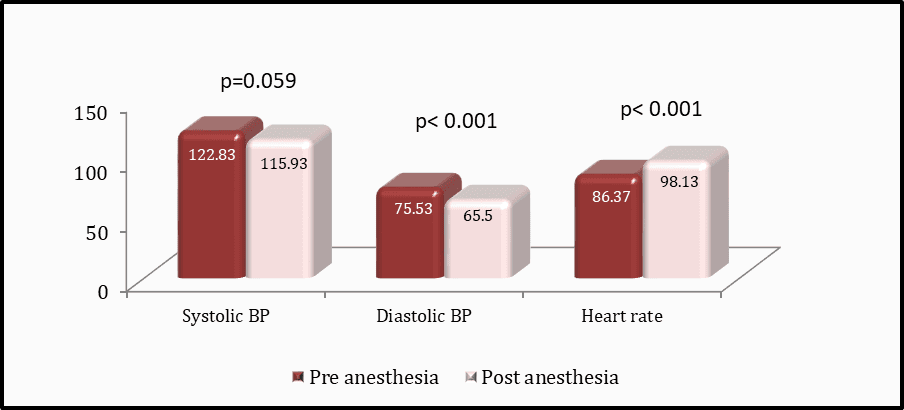
Figure 1. Comparison of systolic, diastolic blood pressure and heart rate pre- and post-fentanyl anesthesia
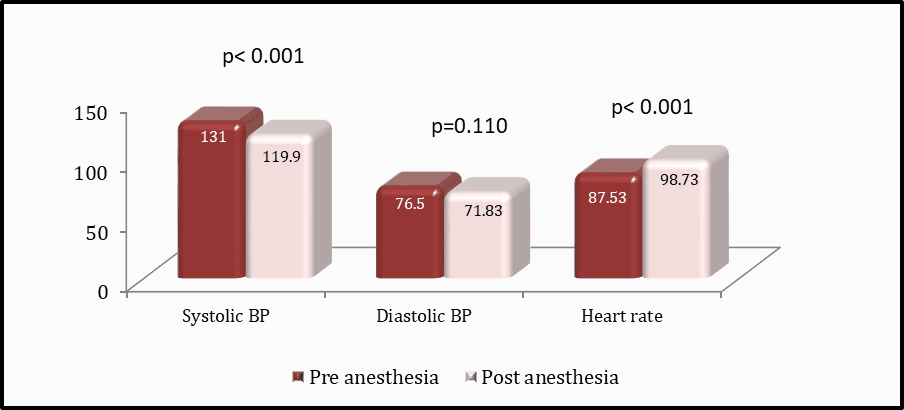
Figure 2. Comparison of systolic, diastolic blood pressure and heart rate pre and post remifentanil anesthesia
The research included the categorization of 90 women who were unable to conceive into two groups. One group of 45 women was administered fentanyl, while the other group of 45 women was given remifentanil during the administration of general anesthesia for the purpose of oocyte retrieval. This study analyzed blood hormone levels, and vital sings. In the operative room, fentanyl and remifentanil are frequently utilized as the first-line treatment for critically ill patients on mechanical ventilation. Nevertheless, these drugs had different pharmacokinetics, metabolisms, and potencies. Their impact on clinical outcomes is not fully known (16).
In the present study the vital signs were compared between two groups of patients before anesthesia; accordingly there was significantly higher systolic blood pressure in remifentanil group (p=0.30); however there were no significant differences in diastolic blood pressure (p=0.767) and heart rates (p=0.512) the results might be explained by these drugs' pharmacokinetic and pharmacodynamics variations. The build-up of opioids poses significant safety risks since it can result in ileus, immunosuppression, respiratory depression, and sedation (17-19). According to studies, opioids having a short half-life might allow for more accurate titration with less drug buildup (20). Remifentanil had shorter half-lives than fentanyl, which could be advantageous in lowering organ accumulation and also lessening the amount of time that ventilation is required.
In our study, we compared the effects of remifentanil and fentanyl on the vital signs pre- and post-anesthesia the results showed significantly lowered both diastolic blood pressure after fentanyl and systolic blood pressure after remifentanil anesthesia (p <0.001), on the contrary, heart rates were significantly higher after both fentanyl and remifentanil anesthesia (p <0.001).
In addition, there was insignificantly lower systolic (p=0.059) and diastolic blood pressure (p=0.110) after fentanyl and remifentanil anesthesia, respectively. Numerous research comparing the effects of remifentanil and other drugs on hemodynamic responses elicited during general anesthesia has been published in peer-reviewed journals. The hemodynamic response to laryngoscopy and intubation was adequately controlled by both regimens when Habib, Parker (21) compared remifentanil bolus (0.5 over 30 seconds) with alfentanil bolus (10 µg/kg over 30 seconds) followed by an infusion (0.1 µg//Kg/min) (21). Remifentanil and desflurane were administered by Sezen et al. to reduce heart rate and blood pressure (22).
When remifentanil and alfentanil infusions were tested during abdominal surgery, Tuncel, Şavlı (23) found that remifentanil was more effective at controlling intraoperative hemodynamic responses (23). However, Farzi, Mehrafza (24) discovered no appreciable variation in hemodynamic parameters between fentanyl and remifentanil (24). Despite the fact that study outcomes might vary greatly depending on a number of variables, including the opioids being studied, additional premedication substances, and the existence of neuromuscular relaxation. Nonetheless, our study's and other research's findings typically show that remifentanil significantly outperforms other drugs in terms of hemodynamic reactions, such as blood pressure and heart rate. This study is the first to compare LH levels before and after fentanyl anesthesia; the results confirm the highly significant difference in LH levels following fentanyl anesthesia; however, FSH levels were somewhat higher following fentanyl anesthesia. Certain authors have studied the effects of opioids from sedation (propofol, diazepam, or midazolam) used for oocyte retrieval with GA (fentanyl with either propofol or isoflurane). They found that increased prolactin levels remained four hours after the operation ended. An increase causes the hypothalamus to release more dopamine, which in turn inhibits the release of gonadotropin-releasing hormone and FSH (25-30).
Additionally, after remifentanil anesthesia, there were considerably greater levels of LH in the current study. Furthermore, after remifentanil anesthesia, there were marginally elevated levels of FSH. This work may be the first to address this subject because no other publication has compared the effects of remifentanil on the hormone concentrations reported in this investigation.
The Associations of LH and FSH with anesthesia are different depending on the type of anesthetic drugs.
The authors would like to express their appreciation to all the individuals who participated in this study.
Authors' Contributions
Each author participated in data analysis, drafting, and revising of the manuscript, and consented to assume responsibility for all aspects of this project.
Conflict of Interest
The author has stated that they do not have any conflicts of interest.
Funding
The research was not specifically funded by any public, commercial, or not-for-profit agencies.

| Article View | 1,280 |
| PDF Download | 508 |
