Iranian Society of Gynecology Oncology (IRSGO)
Document Type : Original Research Article
Authors
1 Medical Laboratory Science Technology, Imamein Kadhimein Medical City, Iraqi Ministry of Health, Baghdad, Iraq
2 College of Health and Medical Technology - Baghdad, Middle Technical University, Baghdad, Iraq
Highlights
✅ According to the results of this study, Cat S has the potential to be a novel vital component among PCOS parameters. Insulin Resistance continues to rise among PCOS women leading to a necessity for studying its specific mechanism and its genetic origins.
Keywords
Polycystic Ovary Syndrome (PCOS) is considered the most prevalent female endocrinopathy, affecting 7–14% of women of reproductive age (1). Menstrual disruption, infertility, hirsutism, acne, and obesity are some of the manifestations of this long-lasting diverse illness (2). It is typically only identified when the side effects manifest and dramatically lower a patient's quality of life (such as hair loss, alopecia, acne, and issues with infertility) (3). Although the specific etiology of this complex condition is unknown, it is generally believed that a combination of genetic and environmental variables are the main contributing factors. The primary factors contributing to the pathophysiology of PCOSare hormonal imbalance, persistent low-grade inflammation, insulin resistance, and hyperandrogenism, all of which impair folliculogenesis and raise the risk of associated comorbidities such as type II diabetes and endometrial cancer (4). Since many women with PCOS appear to have insulin resistance, compensatory hyperinsulinemia is believed to contribute to hyperandrogenism by directly stimulating the production of androgens by the ovaries and inhibiting the liver's ability to synthesize SHGB, which increases the availability of testosterone. Along with amplifying LH-stimulated ovarian steroidogenesis, insulin also promotes ACTH-mediated adrenal androgen synthesis (5, 6). Insulin resistance is documented as a chief risk factor for type 2 Diabetes Mellitus (7, 8). Issues such as obesity and a family history of type 2 Diabetes Mellitus can increase the risk of diabetes in women with PCOS.
Cathepsins are a family of lysosomal proteases with an astoundingly wide range of roles, which help in intracellular housekeeping where they, for instance, contribute to antigen processing throughout immune responses and degrade numerous proteases to sustain cellular homeostasis (9, 10). Cathepsin S belongs to the family of cysteine cathepsin proteases. It is a lysosomal protease that can encourage the endo-lysosomal pathway's destruction of undesirable or damaged proteins. It also plays more specialized roles in the presentation of MHC (Major Histocompatibility Complex) class II antigens, where it is crucial for the degradation of the invariant chain. It should come as no surprise that improper regulation has linked cathepsin S to a number of clinical conditions, such as cancer (11).
It has been demonstrated that circulating Cathepsin S levels are elevated in people with type 2 diabetes (T2D), obesity, dyslipidemia, and decline after weight loss. In this regard, elevated circulating Cathepsin S levels may be a factor in glycemic control issues (12). Cathepsin S has been linked to diabetes and cardiovascular diseases (13, 14). Cathepsin S may play a part in type 2 diabetes mellitus and metabolic diseases due to its positive correlation with insulin resistance and inflammation. In obese individuals, a low-grade inflammatory condition that causes insulin resistance has been linked to higher levels of cathepsin S (15). The present study was performed with aim to investigate the relationship between cathepsin S and Insulin Resistance in Iraqi women with PCOS.
An Observational Case-Control Study was performed. This study was conducted in Baghdad during the period from December to the end of March 2023. The samples were collected from diverse hospitals and infertility health centers. The sample size consisted of 135 participants divided into 2 groups (90 female patients suffering from polycystic ovary syndrome and 45 healthy from medical staff and relatives). The participants' age range was 16 to 40 years at reproductive age.
Inclusion criteria: Based on the gynecologist’s diagnosis, a serum sample from polycystic ovary syndrome patients was collected. Five ml of blood was obtained from vein puncture using a 5 ml disposable syringe, for a period from 9 to 10 a.m. and for a fasting period of 8 to 12 hours. The blood was put in a vacutainer gel tube. After blood clotting at room temperature of about (25 Cº), it was separated by centrifugation at (3000 rpm for 5 min) to collect serum and stored in the freezer at about (-20 Cº) until it was used to assay fasting blood glucose level, fasting insulin level, and Cathepsin S. Cathepsin S and Insulin was estimated by the ELISA kit (Bioassays-China). The estimation of Fasting Blood Glucose was done by COBAS INTEGRA 400 Plus Analyzer. Insulin resistance was calculated using the Homeostatic Model Assessment of Insulin Resistance (HOMA-IR) with the following formula: fasting insulin (mIU/L) × fasting blood glucose (mg/dL)/405.
The data were analyzed using the SPSS (version 20) software, using the independent T-test to find the statistical difference between the means of studied groups and graphical presentation (Bar chart). Pearson coefficient correlation was used to find the correlation of the studied parameters. The ROC curve test also was used to find the sensitivity and specificity of each test. P≤0.05 was considered a significant difference.
Results
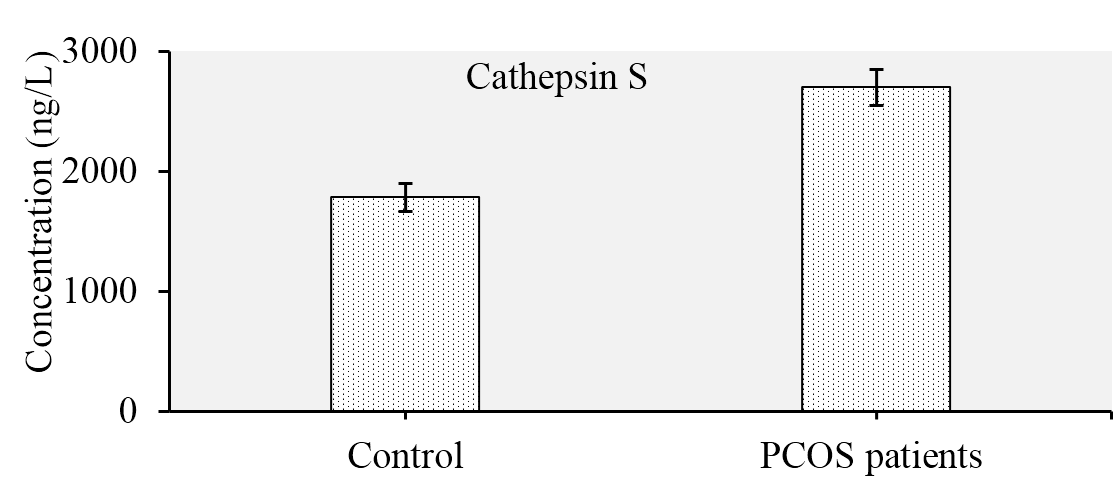
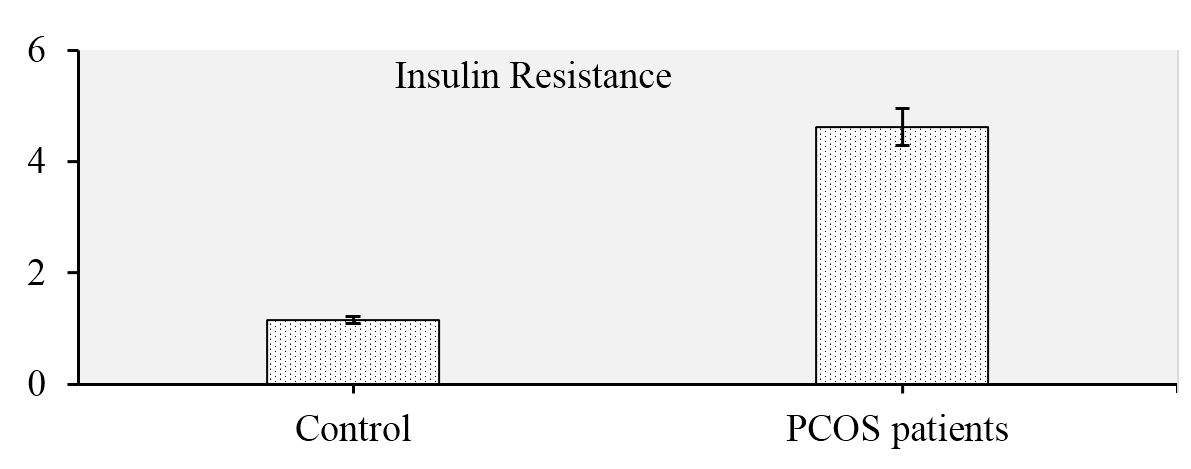
In the present study, 135 participants (90 patients and 45 controls) were investigated. The mean of HOMA-IR, and Cathepsin S in the patient group was 4.63±0.33 and 2697.49±149.30, respectively while these values in the healthy control group were 1.16±0.07 and 1780.96±118.01, respectively. Statistically, these differences between the patients and the control groups were highly significant (HS) (P<0.0001) (Table 1).
| Control Mean±SE |
Patient Mean±SE |
P-value | |
| Cathepsin S | 1780.96±118.01 | 2697.49±149.30 | <0.0001(HS) |
| HOMA-IR | 1.16±0.07 | 4.63±0.33 | <0.0001(HS) |
Discussion
The purpose of the current study was to assess the influence of Cathepsin S alongside insulin resistance on PCOS patients. As far as we know, no one has investigated the effect of Cathepsin Son polycystic ovary syndrome women in Iraq. Polycystic Ovary Syndrome is a chief health disorder linked to a defect in metabolic functions and is considered the most frequently indicated health issue that affects 5–20% of reproductive women (16). Even though PCOS has been known for a very long time, its pathogenesis is still unknown. Cathepsin S is a powerful cysteine protease that breaks down a variety of extracellular substances, including collagen, elastin, and fibronectin. It is highly expressed in macrophages; subcutaneous and visceral adipose tissue both exhibit significant levels of cathepsin S expression (17). According to previous research, some diseases, including atherosclerosis, abdominal aortic aneurysm, cancer, obesity, and type 2 diabetes have been linked to cathepsin S (18). A change in lifestyle in those who are moderately overweight is linked to lower plasma levels of cathepsin S (17).
In the present study, there was an astonishing increase with a high significant difference in cathepsin S levels amongst the PCOS group compared to the control group (Figure 1). There are limited studies concerning cathepsin S’s effect on PCOS or metabolic and endocrine disorders. High Cathepsin S level was linked to metabolic syndrome, a conglomerate of cardiovascular risk factors that comprises obesity, alongside dyslipidemia, dysglycemia, and hypertension (17). According to a survey, PCOS-affected women are more likely to experience negative cardiovascular outcomes like high blood pressure, obesity, and metabolic syndrome (19). As presented in the current study, these similarities between the effect of cathepsin S and polycystic ovary syndrome on patients may explain the high level of this cysteine protease. Earlier research suggested a causal link between the activity of cathepsin S and the inflammatory response; higher circulating levels of Cathepsin S are linked to higher inflammatory activity (20). Numerous studies reviewed how inflammation and inflammatory markers play a vital role in the pathophysiology of polycystic ovary syndrome (21). Furthermore, inflammation also plays a significant part in insulin resistance and obesity, which both linked to PCOS (1, 22). This leaves us with a hypothesis that there is a substantial functional and homeostatic consequence of Cathepsin S on a triangle of metabolic defects involving PCOS, Insulin resistance, and obesity.
The results of the current research showed a high significant increase in the levels of HOMA-IR among PCOS patients compared to the control group (Figure 2). Recent research studied the glucose metabolism and hormone profiles in women with PCOS (23). Their results are consistent with the findings of the present study, HOMA-IR [3.07 (2.14;5.07) in PCOS, 2.02 (1.17;3.20) in control, p<0.001],. The main pathophysiological cause for the plentiful of polycystic ovary syndrome problems seems to be insulin resistance, which can be found in both lean and obese women (24). A greater necessity for insulin to perform metabolic functions is stated as insulin resistance. In women with PCOS, belly fat raises insulin resistance, possibly through subclinical inflammation. The reduced adiponectin levels and an accumulation of fat in the liver, skeletal muscle, and perimuscular tissue might play a distinct role in the etiology of IR in women with PCOS (25). Many recent studies suggest that the link between PCOS and insulin resistance is a combination of genetic, epigenetic environmental and dietary causes (26), which in turn causes metabolic abnormalities and reproductive failure among PCOS women. Hyperinsulinemia occurs as a compensatory reaction to the defective insulin function due to insulin resistance (27). Insulin increases the manufacture of ovarian androgens like testosterone in PCOS women's ovarian theca cells and stops the growth of ovarian follicles. Other organs such as the liver (i.e., inhibition of sex hormone-binding globulin synthesis), and adrenal and pituitary glands are also likely to suffer negative consequences from hyperinsulinemia (28).
Conclusion
As evidenced by the findings of the current research, there was significant increased level of Cathepsins S and HOMA-IR among PCOS patients. Insulin resistance is a major factor in PCOS pathophysiology for decades. This study declared the prevalence of Insulin resistance among Iraqi PCOS women. In addition, we can propose that Cathepsin S shows potential as a novel vital factor among PCOS parameters, particularly if new studies get along with our results. Furthermore, this may be a foundation for the expansion of new pharmaceutical products in the battle against metabolic disorders principally polycystic ovary syndrome. Nevertheless, there must be future research on Cathepsin S on gene expression levels to approve its effect on PCOS and to solve the exact mechanism riddle behind it.
Acknowledgments
We would like to thank the administration, doctors, and staff members at the High Institute of Infertility Diagnosis and Assisted Reproductive Technologies of Al-Nahrain University in Baghdad for their assistance in completing this work, as well as all of the volunteer participants who kindly provided blood samples.
Found or Financial Support
The authors would like to emphasize that no outside funding was used in the research or creation of this publication. The work shown here is the result of our own efforts.
Authors’ Contributions
Walaa Ismaeel Jassim: Conceived and designed the analysis. Zainab Dawood: Collected the data; Contributed data or analysis tools; Performed the analysis; Wrote the paper.
Conflicts of Interest
The authors declare no conflict of interest.

| Article View | 1,053 |
| PDF Download | 592 |