
Iranian Society of Gynecology Oncology (IRSGO)
Document Type : Original Research Article
Authors
1 Department of Obstetrics and Gynecology, Kamal Al-Samaraei Hospital for Management of Infertility and IVF, Baghdad, Iraq
2 Department of Obstetrics and Gynecology, Medical College, Kufa University, Kufa, Iraq
3 Department of Immunology, Kamal Al-Samaraei Hospital for Managment of Fertility and IVF, Baghdad, Iraq
Highlights
✅ AMH emerges as a crucial biomarker that intertwines with various aspects of female reproductive health, including miscarriage history, age, and parity. Future research is needed to deeply investigate the mechanisms behind these associations and offer more comprehensive insights into female fertility dynamics.
Keywords
Recurrent Pregnancy Loss (RPL), also known as recurrent miscarriage, is defined as the loss of two or more pregnancies, which affects about 1-2% of women and can be deeply distressing for couples trying to conceive. It is a challenging scenario faced by both patients and healthcare providers (1). The primary factor leading to the loss of pregnancy during the first trimester is often chromosomal abnormalities of the embryo, commonly known as aneuploidy. Surprisingly, comprehensive tests on patients experiencing miscarriages and evaluating the factors such as anatomical abnormalities, parental karyotypes, immune response, and hormonal balances indicated that —the majority of the results do not reveal any significant abnormalities (1-5). The American Society for Reproductive Medicine (ASRM) and the European Society of Human Reproduction and Embryology (ESHRE) advise expectant management (EM) as the preferred care approach for those dealing with unexplained RPL (1, 2). Although ovarian reserve testing is not regularly suggested as part of the diagnostic procedure for RPL patients (1), it is recommended for women struggling with infertility. This is because it has been proven useful in predicting the response to gonadotropin stimulation during fertility treatments, such as in vitro fertilization (IVF) (6, 7). Nonetheless, the efficacy of biomarkers like Anti-Mullerian Hormone (AMH) in predicting the overall reproductive potential remains uncertain. A comprehensive prospective cohort study on fertile women attempting natural conception found no direct correlation between AMH levels and fecund ability (the probability of achieving pregnancy in a given menstrual cycle) (8). Yet, further analysis of pregnancy outcomes suggested an inverse relationship between AMH levels and miscarriage risk that based on the conventional understanding some might expect that low AMH often corresponds to diminished ovarian reserve and potentially reduced egg quality (9, 10). The implication of AMH in forecasting reproductive potential in women with RPL—defined as those experiencing two or more previous pregnancy losses—remains unclear. In previous studies, no association was found between AMH levels and fecundability in women attempting natural conception after one or two previous pregnancy losses, and live birth rates were not separately assessed (11, 12). When considering women who have endured multiple pregnancy losses, one could argue that their primary aim is to achieve live birth rather than just clinical pregnancy. Therefore, the current study was performed with aim to investigate the potential role of AMH in predicting the rate of live birth in women with RPL who are trying to conceive naturally.
This cross-sectional study was conducted on 60 pregnant women referred to Baghdad and Al-Najaf infertility centers during June 2022 to June 2023. The women's data including age (years), gestational age (weeks), miscarriage frequency; number of abortions before 28 weeks of gestation, and fetal outcomes (intrauterine death, preterm birth from 28 to 37 weeks of gestation and term birth (lived baby) were recorded. Also, all females asked about parity and number of lived baby. The level of Anti-Mullerian Hormone (AMH) was measured by Minividas Biomeriux company 2020 (France), principle of method chemo immuneflourcent, AMH kit.
After measurement of AMH, we do hormonal level for FSH and Estradiol to see if correlate with the level of AMH or not and if the AMH was very law we surge for other causes like autoimmune disorder by surging Antibodies level and genetic disorder by karyotyping. Inclusion criteria we are take all pregnant lady that get pregnancy spontaneous or by induction of ovulation with history of recurrent miscarriage. Exclude those with unexplained pregnancy loss and those with male factor causes
The statistical analysis was conducted using SPSS version 22. Categorical data was analyzed using frequency and percentage while continuous data was examined using measures of central tendency and variability, such as mean, median, and standard deviation (SD). The Chi-square test was employed to investigate the relationship between categorical variables. Moreover, the t-test was utilized for comparing the mean and median of continuous variables. P≤ 0.05 was considered statistically significant.
For analyzing used SPSS software version 22, and results were reported as mean ± SD.
Results
In the current study, 60 pregnant women with mean age of 32.8±7 years participated. According to the results presented in Table 1, 46.7% of women were at age group 21-30 years old, 73.3% had less than 37 weeks’ gestational age of current gestation, 55% had 2 times frequency of abortion, and 66.7% of participants had intrauterine death, while 26.7% of them had lived baby.
In the current research, 48.33% of participants were nulliparous, while 28.33% of them had 1 parity and 23.34% of women had 2 parities (Figure 1).
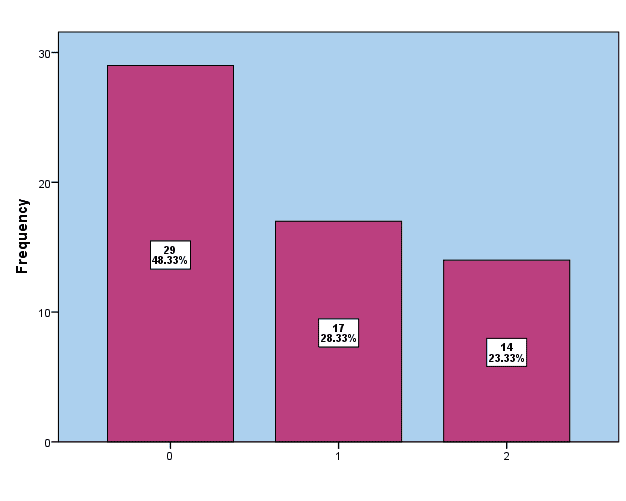
As shown in Table 2, there was a significant difference in the mean of AMH and miscarriage frequency, the women with 2 time of abortion had higher AMH levels than those with 4-times abortion. (P-value =0.003).
The findings in Table 3 showed that there was no significant difference in the mean of AMH and pregnancy outcomes. (P-value =0.9).
As shown in Table 4, significant difference was found in the mean of AMH and the age groups of the participants; the women at age group 21-30 years had higher AMH levels than those at age group >40 years. (P-value =0.0001).
The results presented in Table 5 showed no significant difference in the mean of AMH levels and gestational age (weeks) of the participants. (P-value =0.7).
As the findings of Table 6 showed, there was a significant difference in the mean of AMH levels and parity; the women with 2 parities had higher AMH levels than nulliparous women. (P-value =0.003).
As shown in Table 7, significant association was found between age group and miscarriage frequency. In this regard, 100% of females with 4 times miscarriage frequency were at age group >40 years. (P-value =0.0001).
| Variables | frequency | percentage | |
| Age groups/years | 21-30 | 28 | 46.7 |
| 31-40 | 19 | 31.7 | |
| >40 | 13 | 21.7 | |
| Gestational age (weeks) | <37 | 44 | 73.3 |
| ≥37 | 16 | 26.7 | |
| Miscarriage frequency | 2 | 33 | 55.0 |
| 3 | 21 | 35.0 | |
| 4 | 6 | 10.0 | |
| Outcome | IUD | 40 | 66.7 |
| Pregnancy outcome | Preterm | 4 | 6.7 |
| lived | 16 | 26.7 |
| Miscarriage | N | Mean of AMH | Std. Error | P-value | |||||
| 2 | 33 | 2.9 | 0.35 | 0.003 | |||||
| 3 | 21 | 1.6 | 0.50 | ||||||
| 4 | 6 | 0.03 | 0.01 | ||||||
| Pregnancy Outcome | N | Mean of AMH | Std. Error | P-value | |||||
| IUD | 40 | 2.1 | 0.42 | 0.9 | |||||
| Preterm | 4 | 1.8 | 0.07 | ||||||
| Lived | 16 | 2.38 | 0.13 | ||||||
| Age groups/years | N | Mean of AMH | Std. Error | P-value | |||||
| 21-30 | 28 | 3.8 | 0.41 | 0.0001 | |||||
| 31-40 | 19 | 1.0 | 0.16 | ||||||
| >40 | 13 | 0.3 | 0.20 | ||||||
| Gestational age (weeks) Of current gestation |
N | Mean of AMH | Std. Error | P-value | |||||
| <37 | 44 | 2.1650 | 0.38 | 0.7 | |||||
| ≥37 | 16 | 2.3875 | 0.13 | ||||||
| Parity | N | Mean of AMH | Std. Error | P-value | |||||
| 0 | 29 | 1.3017 | 0.37 | 0.003 | |||||
| 1 | 17 | 2.7241 | 0.49 | ||||||
| 2 | 14 | 3.5286 | 0.55 | ||||||
| Variables | Age groups/year’s Total | P-value | |||||||
| 21-30 | 31-40 | >40 | |||||||
| 2 | 20 | 11 | 2 | 33 | |||||
| Miscarriage | 60.6% | 33.3% | 6.1% | 100.0% | |||||
| 3 | 8 | 8 | 5 | 21 | 0.0001 | ||||
| Frequency | 38.1% | 38.1% | 23.8% | 100.0% | |||||
| 4 | 0 | 0 | 6 | 6 | |||||
| 0.0% | 0.0% | 100.0% | 100.0% | ||||||
| Outcome | N | Mean of AMH | Std. Error | P-value |
| IUD | 40 | 2.1 | 0.42 | 0.9 |
| Preterm | 4 | 1.8 | 0.07 | |
| Lived | 16 | 2.38 | 0.13 |
| Age groups/years | N | Mean of AMH | Std. Error | P-value |
| 21-30 | 28 | 3.8 | 0.41 | 0.0001 |
| 31-40 | 19 | 1.0 | 0.16 | |
| >40 | 13 | 0.3 | 0.20 |
| Gestational age (weeks) | N | Mean of AMH | Std. Error | P-value |
| <37 | 44 | 2.1650 | 0.38 | 0.7 |
| ≥37 | 16 | 2.3875 | 0.13 |
| Parity | N | Mean of AMH | Std. Error | P-value |
| 0 | 29 | 1.3017 | 0.37 | 0.003 |
| 1 | 17 | 2.7241 | 0.49 | |
| 2 | 14 | 3.5286 | 0.55 |
| Variables | Age groups/year’s Total | P-value | ||||
| 21-30 | 31-40 | >40 | ||||
| 2 | 20 | 11 | 2 | 33 | ||
| Miscarriage | 60.6% | 33.3% | 6.1% | 100.0% | ||
| 3 | 8 | 8 | 5 | 21 | 0.0001 | |
| Frequency | 38.1% | 38.1% | 23.8% | 100.0% | ||
| 4 | 0 | 0 | 6 | 6 | ||
| 0.0% | 0.0% | 100.0% | 100.0% | |||
Discussion
The purpose of the present study was to investigate the potential role of antimullerian hormone (AMH) in predicting the rate of live birth in women with RPL who are trying to conceive naturally. The results of this study showed that the mean age of participants was 32.8±7 years. Nearly half (46.7%) were in the 21-30 years’ age group. This was consistent with global trends showing that many women choosing to have children in their late 20s to early 30s (13). It's noteworthy that in the current research, 73.3% of women presented at less than 37 weeks' gestational age. Premature births, those occurring before 37 weeks of gestation, have been associated with various complications both for the mother and neonate (14). Recurrent pregnancy loss, indicated by the 55% of females with a history of two miscarriages, remains a challenging aspect of reproductive medicine. Multiple factors, such as genetic to environmental, can contribute to recurrent pregnancy losses (2). Alarmingly, 66.7% of the women in this study experienced intrauterine fetal death. Intrauterine fetal death, or stillbirth, can be caused by various reasons, including placental abnormalities, infections, and maternal health issues like hypertension (15). The high rate in this research might warrant a closer look at the underlying causes, risk factors, and potential interventions. Moreover, 26.7% of the women in this study had a live baby, 4 babies were preterm, 1 of them dead and 3 babies were lived. Successful pregnancy outcomes are influenced by a combination of factors such as maternal health, access to prenatal care, and genetics (16). Parity, which refers to the number of times that an woman has given birth to a fetus with a gestational age of 24 weeks or more, regardless of whether the child was alive or stillborn, is a significant factor in maternal and neonatal health. In this study, nearly half (48.33%) of the women were nulliparous. This rate reflects global trends where women, especially in urban settings or developed countries, are single child family due to reasons ranging from career priorities, educational pursuits, to personal choices (17). The data reveals that 28.33% of the women have a parity of 1, indicating they have given birth once. Single-child families are becoming increasingly common, influenced by socioeconomic factors, urbanization, and individual choices (18). As the results of the present study showed, 23.43% of women had 2 parities. However, globally, having two children is often seen as the norm or ideal family size in many cultures. A two-child norm has been influenced by the factors like economic constraints, work-life balance, and the perception of ensuring optimal resources and attention for both children (19). Anti-Müllerian hormone (AMH) is an established marker of ovarian reserve, with levels being reflective of the number of antral follicles in the ovaries (20). The data presented in the current research underscores a potential relationship between AMH levels and several reproductive factors. Women with a history of two miscarriages had significantly higher AMH levels than those who reported four miscarriages. This observation might hint at a link between ovarian reserve and recurrent pregnancy loss. Some studies have posited that diminished ovarian reserve could be associated with increased rates of miscarriage due to potential diminished oocyte quality (21). However, it's interesting to note that in the current research, there was no significant difference in AMH levels and the pregnancy outcome. This suggests that while AMH might play a role in miscarriage rates, it doesn't necessarily predict the success of a given pregnancy in terms of live birth. The data also revealed expected findings related to age. AMH levels naturally decrease with increased age, so it's consistent that women in the 21-30 age group displayed higher AMH than their counterparts over 40 years old (22), this reduction is typically due to a decrease in the number of ovarian follicles available as women aging. The absence of any significant difference in AMH values and gestational weeks in the present study suggests that the immediate state of pregnancy might not impact the AMH levels, echoing findings from other studies (23). Interestingly, in the current research, parity was shown to influence AMH values. Women with two parties had elevated AMH levels compared to nulliparous women. It's a somewhat unexpected finding, given that parity has not traditionally been associated with ovarian reserve (24). This raises questions about potential underlying mechanisms that might link reproductive history with ovarian reserve. Lastly, the association between age and miscarriage frequency, particularly the fact that all women over 40 in this study who experienced four abortions, is indicative of the compounded challenges older women might face in their reproductive journeys (12).
Conclusion
The findings of the present study underscore the importance of Anti-Müllerian hormone (AMH) as an indicative marker of ovarian reserve, revealing significant associations with miscarriage frequency, age, and parity. Notably, women with fewer miscarriages presented with higher AMH levels, suggesting a possible link between robust ovarian reserve and reduced miscarriage rates. Conversely, the direct outcome of pregnancies and gestational age did not show any significant influence on AMH levels. Age, as expected, showed a direct correlation with AMH levels, reinforcing the notion that ovarian reserve diminishes as women aging. Of particular concern is the observation that all females over the age of 40 had experienced four miscarriages, highlighting potential reproductive challenges in this age group. The association between parity and AMH levels, where women with two parities displayed elevated AMH compared to nulliparous women, introduces fresh perspectives on the interplay between reproductive history and ovarian reserve.
Acknowledgments
To all medical staff in Baghdad and Al-Najaf infertility centers for helped in collected of data.
Funding Source
None.
Conflicts of Interest
None.

| Article View | 2,605 |
| PDF Download | 747 |
