
Iranian Society of Gynecology Oncology (IRSGO)
Document Type : Original Research Article
Authors
1 Department of Assisted Reproduction Techniques, Basrah Teaching Hospital for Maternity and Paediatrics, Basra, Iraq
2 Department of Obstetrics and Gynecology, Medical College, Kufa University, Al-Najaf, Iraq
3 Infertility Diagnosis and ARTs institute, Al Nahrain University, Baghdad, Iraq
Highlights
✅ The study highlights AMH as an indicator of ovarian reserve decline in females aged ≥ 35 years, while emphasizing the multifaceted determinants of infertility and IVF success.
Keywords
The success of Controlled ovarian hyperstimulation (COH) in In vitro fertilization (IVF) largely rests upon the precise prediction of ovarian response using patient-specific attributes and biomarkers. One such biomarker is Antimüllerian hormone (AMH), which belongs to the transforming growth factor-&betaa; superfamily (1). Mainly produced by the granulosa cells (GCs) of pre-antral and small antral follicles (2), AMH serves as a reliable indicator of ovarian reserve (3). Its role is pivotal as it restricts the primary recruitment of follicles and deters FSH-driven follicle growth and selection (4). Remarkably consistent both within and between menstrual cycles, AMH exhibits a well-defined correlation with the ovarian response during COH (5, 6). Furthermore, the response of the ovaries in terms of quantity during stimulation can be linked with AMH. There are also suggestions that AMH could be connected with the qualitative outcomes of Assisted reproductive technology (ART) like clinical pregnancies and live births, regardless of the patient's age (7). Yet, such connections remain debated. In two meta-analyses focused on the correlation between AMH and pregnancy results for IVF patients, there was only a faint connection observed with implantation, pregnancy, and live births, making AMH's predictive prowess for such results questionable (8). The variance seen across different studies regarding AMH's connection with pregnancy outcomes can be attributed to several factors including differences in patient groups, the methods of stimulation adopted, the specific AMH tests used, ultrasound procedures, among others. It is crucial to note that AMH's predictive capacity for ART results might differ considerably based on the infertility patient's specific condition. Notably, Polycystic ovarian syndrome (PCOS) is the predominant endocrine anomaly impacting women in their reproductive years, with its prevalence hovering between 5–8%. The AMH levels in the serum have been linked with the severity of PCOS (9), potentially distorting the correlation between AMH and IVF results. Hence, to discern AMH's predictive strength for IVF results in certain infertility patient groups, our focus was directed specifically towards women diagnosed with PCOS. The aim of the study is to assess the association of antimüllerian hormone with polycystic ovarian syndrome and pregnancy outcomes of in vitro fertilization cycles with fresh embryo transfer.
Cross-sectional study of 55 infertile females have PCOs to undergo in vitro fertilization cycles the study done in Baghdad and Al-Najaf infertility centers, from June 2022 to June 2023. All female data are: Age groups (years), AMH level Ng/ml, Period of infertility (years), Male factors for infertility, Outcome (pregnancy test), factors that cause infertility. Using SPSS 22 (IB, USA), frequency and percentage are utilized for categorical data, while mean, median, and SD are utilized for continuous data. The Chi-square was used to evaluate the association between categorical variables. P-values less than or equal to 0.05 were considered statistically significant.
Results
Cross-sectional study was performed on 55 infertile females with PCOs who underwent in vitro fertilization cycles. Mean age (30 ± 6 years), 78.2% less than 35 years old, 38.2% had a fertility period 2–5 years, just only 30.9% of causes of their infertility was males’ side, just 29.1% of them got pregnant, 72.7% had AMH level 2025-5.71 ng/ml. as shown in Table 1.
| variables | frequency | percentage | |
| Age groups (years) | <35 | 43 | 78.2 |
| 35 and more | 12 | 21.8 | |
| AMH level | 2.25-5.71 | 40 | 72.7 |
| Ng/ml | > 5.71 | 15 | 27.3 |
| Period of infertility (years) | 2-5 | 21 | 38.2 |
| 6-10 | 16 | 29.1 | |
| >10 | 18 | 32.7 | |
| Male factors for infertility | normal | 38 | 69.1 |
| yes | 17 | 30.9 | |
| Outcome (pregnancy test) | Negative | 39 | 70.9 |
| Positive | 16 | 29.1 |
As shown in Fig. 1; 80% of females have no association factors that cause infertility, 7.27% have bilateral tubal blockage, and 3.64% have previous CS and so on.
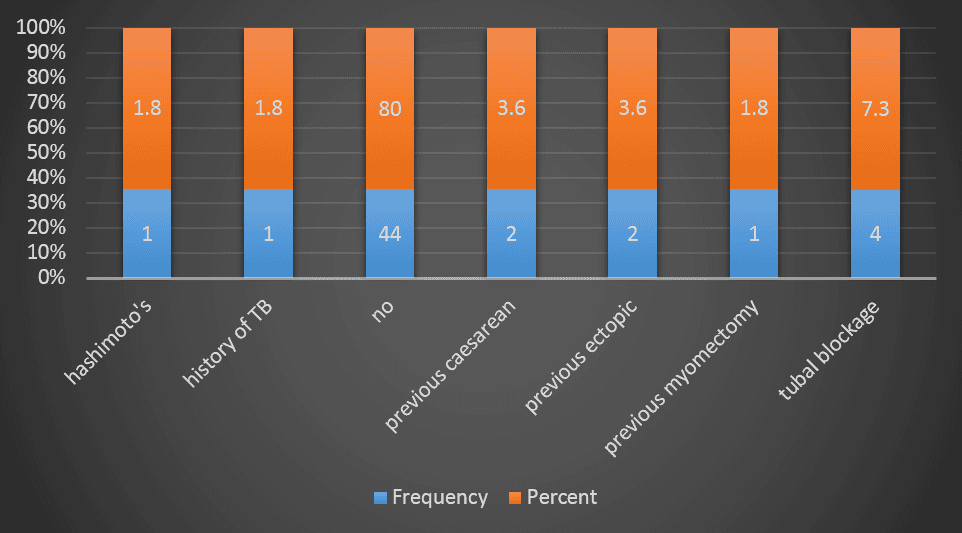
As shown in Table 2; there is significant association between AMH and (Age groups), 100% of females with age groups ≥ 35 years have AMH level (2.25-5.71 ng/ml), but there is no significant association between AMH and (Period of infertility, Outcome, Protocol Used). Also, there is no significant association between age group and Period of infertility, as shown in Table 3.
| Variables | AMH | Total | P-value | |||
| 2.25-5.71 | > 5.71 | |||||
| Age groups | <35 | 28 | 15 | 43 | ||
| (years) | 65.1% | 34.9% | 100.0% | 0.024 | ||
| 35 and more | 12 | 0 | 12 | |||
| 100.0% | 0.0% | 100.0% | ||||
| Period of | 2-5 | 12 | 9 | 21 | ||
| infertility | 57.1% | 42.9% | 100.0% | |||
| (years) | 6-10 | 14 | 2 | 16 | 0.1 | |
| 87.5% | 12.5% | 100.0% | ||||
| >10 | 14 | 4 | 18 | |||
| 77.8% | 22.2% | 100.0% | ||||
| Outcome | negative | 30 | 9 | 39 | ||
| 76.9% | 23.1% | 100.0% | 0.4 | |||
| positive | 10 | 6 | 16 | |||
| 62.5% | 37.5% | 100.0% | ||||
| Protocol | agonist | 14 | 2 | 16 | ||
| Used | 87.5% | 12.5% | 100.0% | 0.18 | ||
| Antagonist | 26 | 13 | 39 | |||
| 66.7% | 33.3% | 100.0% | ||||
| Variables | Age groups (years) | Total | P-value | |||
| <38 | ≥38 | |||||
| Period of | 2-5 | 19 | 2 | 21 | ||
| infertility | 90.5% | 9.5% | 100.0% | |||
| (years) | 6-10 | 13 | 3 | 16 | 0.7 | |
| 81.3% | 18.8% | 100.0% | ||||
| >10 | 15 | 3 | 18 | |||
| 83.3% | 16.7% | 100.0% | ||||
P-value ≤ 0.05 (significant).
Discussion
This cross-sectional study on 55 infertile females diagnosed with PCOS undergoing in vitro fertilization provides valuable insights into the relationship between PCOS, age, fertility duration, the causes of infertility, and AMH levels. It's notable that the mean age of the females is 30 ± 6 years, with 78.2% being under 35. This prevalence is consistent with the understanding that PCOS is predominantly diagnosed in younger women, and age is a significant determinant of fertility, with women under 35 having a higher potential for positive IVF outcomes (10). This age distribution is especially important given that age-related decline in fertility is a well-established phenomenon, and younger age is generally associated with a more favorable ovarian reserve and better-quality oocytes, which are crucial for successful IVF (11). Regarding the duration of infertility, 38.2% of the females reported a fertility period of 2–5 years. This finding underscores the chronic nature of PCOS and its role in prolonging the period of infertility. Chronicity of infertility might affect the psychological well-being of the patients, impacting their overall health and potentially the IVF success rates (12). Interestingly, only 30.9% reported that the cause of their infertility was attributed to the male partner. Male factors have been recognized as contributing to infertility in around 40-50% of all cases globally (13). In this specific cohort of PCOS women, the male contribution is lower than the global average, suggesting that PCOS is a dominant factor in the observed infertility. However, it's concerning that only 29.1% of the cohort achieved pregnancy. This is a critical observation, as it indicates that despite the majority of these women being younger (which is generally more favorable for IVF), other factors, possibly associated with PCOS, might be hindering the success rate. The exact mechanisms need to be explored in more detail. The AMH levels recorded in 72.7% of the participants fell within the 2.025-5.71 ng/ml range. Elevated AMH levels have been previously associated with PCOS, serving as both a diagnostic criterion and an indicator of the severity of the condition (14). The relationship between AMH levels and IVF outcomes in PCOS women is intricate. While higher AMH levels suggest a good ovarian reserve, in PCOS patients, it might not necessarily predict a favorable IVF outcome, as observed in the current study. Elevated AMH levels in PCOS patients might reflect the abundance of antral follicles, but not necessarily their quality (15). The study highlights the challenges in diagnosing female infertility. A significant 80% of the subjects had "unexplained infertility," a scenario where standard diagnostic tests fail to identify the cause, leading to patient and clinician frustration (16, 17). This condition also places immense psychological stress on patients due to the uncertainty surrounding their fertility prospects (18). Another finding was the 7.27% of subjects with tubal blockage, often resulting from conditions like pelvic inflammatory disease or prior surgeries, preventing natural conception. For these cases, IVF is frequently the advised treatment (19, 20). Additionally, 3.64% had a history of Cesarean sections (CS). While CS itself isn't a direct infertility cause, post-operative complications like adhesions could impede fertility (21). Furthermore, scars from CS, especially in the uterine wall, might pose risks in future pregnancies (22), though the connection between CS and subsequent infertility remains inconclusive (23). The study underscores a significant association between AMH levels and age, with findings aligning with previous literature that AMH decreases as ovarian follicles reduce in number and quality with age (24). Specifically, females aged ≥ 35 years in the study consistently showed AMH levels indicating a decline in ovarian reserve (25). However, there was no clear association between AMH levels and the duration of infertility, suggesting that other infertility factors, such as male infertility or tubal issues, might be influential (26). Additionally, despite some studies indicating a link between higher AMH levels and positive IVF outcomes (27), this research did not find such an association, highlighting the complex interplay of factors that determine IVF success (28). The absence of a significant association between age group and the period of infertility in this study suggests that while age is an undeniable factor in reproductive potential, the duration of infertility might not necessarily increase linearly with age. Several studies have shown that age, especially advancing maternal age, is closely related to a decline in both the quantity and quality of oocytes (29). However, the period of infertility can be influenced by a myriad of factors beyond age, such as male factor infertility, environmental exposures, lifestyle factors, and underlying medical conditions, among others (30).
Conclusion
The study reveals a distinct correlation between AMH levels and age, emphasizing AMH's role as an indicator of declining ovarian reserve, particularly in females aged ≥ 35 years. Conversely, the duration of infertility and IVF outcomes did not show a consistent relationship with AMH levels, underscoring the multifactorial nature of infertility and the complexities surrounding IVF success predictors.
Acknowledgments
To all medical staffs in Baghdad and Al-Najaf infertility centers for helped in collected of data.
Conflicts of Interest
No conflict of Interest.

| Article View | 1,407 |
| PDF Download | 742 |
