
Iranian Society of Gynecology Oncology (IRSGO)
Document Type : Original Research Article
Authors
1 Cancer Research Center, Health Research Institute, Babol University of Medical Sciences, Babol, Iran
2 Clinical Research Development Unite of Rouhani Hospital, Babol University of Medical Sciences, Babol, Iran
3 Student Committee Research, Babol University of Medical Sciences, Babol, Iran
4 Social Determinants of Health Research Center, Health Research Institute, Babol University of Medical Sciences, Babol, Iran
5 Infertility and Reproductive Health Research Center, Health Research Institute, Babol University of Medical Sciences, Babol, Iran
Highlights
✅ Preoperative leukocytosis and thrombocytosis are related to the severity, stages, and grades of EC. Both of them have a prognostic role in women suffering from EC.
Keywords
Endometrial cancer (EC) is one of the main common neoplasms in women, following cancers of the breast, colon, and lung (1), and it is the eighth cause of death due to malignancy (2). The American Cancer Society (ACS) estimated that there were 6,3230 new cases of uterine cancer in the United States (US) in 2018, and around 1,1350 women died from uterine cancers of which 8% were sarcomas and the rest were related to endometrial carcinoma (3). The incidence of EC is 10% in menopausal women. Age, bleeding severity, body mass index (BMI), and internal diseases are associated with suffering from EC (4) A study in Iran showed that 15.9% of patients suffering from EC were less than 40 years old (5). Paraneoplastic syndrome is not related to direct tumor invasion, it is a set of signs and symptoms, but it can be the result of the presence of malignant cells in different parts of the body. Hematologic manifestations include leukocytosis, anemia, and thrombocytosis (6). Thrombocytosis is associated with a higher degree of genital malignancy (7). Anemia, thrombocytosis, leukocytosis, and other factors of paraneoplastic blood are commonly found in a variety of malignancies, it is found especially in their advanced type (8).
Njølstad, et al. (9) have suggested that anemia, leukocytosis, and thrombocytosis detection are separately associated with the detection of aggressive EC and can reduce mortality rates in these patients (9). Andersen, et al. (7) showed that only 18.1% of the patients with early stages of EC had anemia and thrombocytosis. Patients with advanced stages of cancer, anemia, leukocytosis, and thrombocytosis had a short five-year relative survival rate (7). Vernooij, et al. (10) reported that leukocytes, hemoglobin (Hb), and platelets, estimated ovarian cancer and EC based on different stages and grades (10). So, a reliable preoperative diagnosis to prognosticate the malignancy and stage of the disease can accelerate the referral of patients to specialized centers and improve the survival rate of the patient (7, 10).
The investigation found that blood cells and related disorders can serve as useful prognostic markers at the time of cancer diagnosis for prognosis and treatment decisions. But in different countries, the age, gender, geographical location, and ethnicities of the population under investigation are different (6). Therefore, different results may be obtained due to the potential difference caused by different geographical and ethnic factors. So, the present research aimed to investigate the prognostic role of leukocytosis, anemia, and preoperative thrombocytosis on endometrial tumors of women undergoing surgery in Mazandaran province. Correlation and simultaneous investigation of all three blood markers (Anemia, thrombocytosis, and leukocytosis) have been underestimated as predictors of EC. Therefore, final desirable outcomes can be performed simultaneously as predictive tests for malignancy and the stage of EC.
In this cross-sectional study, 105 women with confirmed EC underwent surgery for EC treatment in Ayatollah Rouhani hospital, Babol city, Mazandaran province, from 2011 to 2018. The pathology center of this hospital confirmed the presence of cancerous tissue. Their blood parameters, as well as cancer grading and staging, were examined.
The inclusion criteria were patients with a final diagnosis of EC and complete information in the records. Patients with incomplete information in the records, concurrent or previous concurrent diseases, autoimmune diseases, blood diseases, thalassemia minor, and inflammatory diseases as well as patients who were recipients of neoadjuvant chemotherapy and steroids were excluded from the present study based on the records.
The Ethics Committee of the Babol University of Medical Sciences approved this research (MUBABOL.HRI.REC.1396.157). After that, patient information including demographic characteristics, BMI, midwifery records, type of malignancy, Hb levels, white blood cell (WBC) count, preoperative platelet count, histological information on malignancy, cancer grading and staging based on lymph nodes, degree of myometrial infiltration, ascites, omentum involvement, liver involvement, and distant metastasis was extracted from documentation in the records and pathology report. The complete blood count (CBC) was interpreted (Sysmex KS21, Sysmex, japan). In the case of receiving a preoperative blood transfusion, the pre-transfusion sample was used. According to the World Health Organization (WHO) standard for non-pregnant women, anemia as Hb level <12 g/dl (8), leukocytosis as WBC count >109×10 ml, and thrombocytosis as platelet count (PC) >390×109 ml were defined. Then, the patients were placed at stages I, II, III, and IV based on the mean of Hb, WBCs, and platelets, and ECs were graded as well, moderately and poorly differentiated or undifferentiated for statistical comparison.
Statistical Analysis
Statistical Package for the Social Sciences (SPSS software, version 22, IBM, USA) and receiver operating characteristic (ROC) was used for statistical analysis. The area under the ROC curve was calculated as the diagnostic accuracy of each blood parameter with a 95% confidence interval. Chi-square and analysis of variance (ANOVA) tests were performed for quantitative and qualitative variables, respectively (p < 0.05).
Results
Demographic and Blood Cells Characteristics
In this study, 105 patients suffering from EC were studied. The mean age of the patients in this study was 53.70 years. The mean of WBCs, hemoglobin and platelets was 8873.33 cells/ml, 11.09 g/dL and 307209.00 cells/ml, respectively (Table1).
Association between Grade and Stage of the Tumor with Three Indices of EC
In the evaluation of tumor grade with leukocytosis, anemia, and thrombocytosis in EC patients, it was found that 54.3% of patients with leukocytosis had tumor grade III. This rate was higher than both the tumor grades 1 (11.4%) and 2 (34.3%). The relationship between tumor grade and leukocytosis was statistically significant (p<0.001). A higher rate of anemia (47.4%) was observed in patients with tumor grade I. There was no statistically significant between tumor grade and anemia (p=0.72). A higher rate of thrombocytosis (66.7%) in patients with thrombocytosis tumor grade III was observed. The relationship between tumor grade and thrombocytosis was statistically significant (p<0.001). A higher rate of leukocytosis (51.4%), anemia (60.5%), and thrombocytosis (51.9%) were detected in tumor stages III, I, and III, respectively. The relationship between tumor stage, leukocytosis, and thrombocytosis was statistically significant, too (p<0.001). There was no statistically significant between tumor stage and anemia (p=0.260) (Table 2).
Relationship between Grades of Tumor and all Three Indices of EC
In total, 66.7% and 38.1% of EC patients who suffered from all three leukocytosis, anemia, and thrombocytosis were at grades III (p<0.001) and stage IV (p<0.001), respectively, which statistically indicated a significant relationship (Table 3).
ROC Curve for the Association of WBC, Hb, and Platelets with Grade and Stage of EC
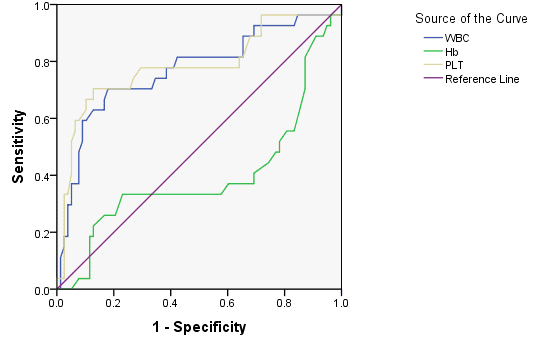
The cut-off point was calculated based on the grade for in vitro variables such as WBCs, Hb, and PC in patients suffering from EC and based on a 95% confidence interval for the area under the curve (AUC). The WBC count cut-off point was 9550,000 per/ml with a sensitivity and specificity of 70 and 70 %, respectively. As well as the Hb cut-off point was 11.05 g/dl with a sensitivity and specificity of 37 and 39%, respectively. Based on the ROC curve assessment, the cut-off point of platelets was 32,800 per/ml with sensitivity and specificity of 73 and 74 %, respectively. The cut-off point was calculated based on the stage for in vitro variables such as WBCs, Hb, and PC in patients suffering from EC and based on a 95% confidence interval for AUC. The sensitivity and specificity of WBC at the cut-off point of 9650000 per ml were 84% and 88%, respectively. Also, the sensitivity and specificity of Hb at the cut-off point of 11.05 g/dl were estimated at 42% and 40%, respectively. An appropriate platelet cut-off of 325,000 per/ml was detected; the sensitivity and specificity were 75% and 73%, respectively (Fig 1).
The level below the 3-Variable Curve with Grade and Stage of EC
The level below the 3-variable curve with grade in patients suffering from EC showed that there was a significant relationship between the level below the 3-variable curve and WBC (p <0.001) and platelet (p<0.001). Also, the significant relationship between tumor stage with WBC (p<0.001) and platelet (p<0.001) was absorbed (Table 4)
| Variables | EC Mean ± SD |
| Age (year), | 53.70 ± 9.95 |
| WBCs (cell/ml) | 8873.33 ±2657.04) |
| Hemoglobin (g/dL) | 11.09 ± 1.59 |
| Platelet (cell/ml) | 307209.00 ±100583.65 |
| Variables | Tumor Grade | P- value | ||||
| I N (%) |
II N (%) |
III N (%) |
||||
| Lococytosis No Yes |
45 (64.3) 4 (11.4) |
17 (24.3) 12 (34.3) |
8 (11.4) 19 (54.3) |
0.001> | ||
| Anemia No Yes |
13 (14.8) 36 (47.4) |
7 (24.1) 22 (28.9) |
9 (31.0) 18 (23.7) |
0.72 | ||
| Thrombocytosis No Yes |
47 (60.3) 2 (7.4) |
22 (28.2) 7 (25.9) |
9 (11.5) 18 (66.7) |
0.001> | ||
| Variables | Tumor Stage | |||||
| I N (%) |
II N (%) |
III N (%) |
IV N (%) |
|||
| Lococytosis No Yes |
61 (87.1) 6 (17.1) |
4 (5.7) 1 (2.9) |
5 (7.1) 18 (51.4) |
- 10 (28.6) |
>0.001 | |
| Anemia No Yes |
21 (74.4) 46 (60.5) |
- 5 (6.6) |
7 (24.1) 16 (21.1) |
1 (3.4) 9 (11.8) |
0.26 | |
| Thrombocytosis No Yes |
64 (82.1) 3 (11.1) |
4 (5.1) 1 (3.7) |
9 (11.5) 14 (51.9) |
1 (1.3) 9 (33.3) |
>0.001 | |
| Variables | Tumor Grade | |||||
| I N (%) |
II N (%) |
III N (%) |
P- value | |||
| Without indices | 12 (54.5) | 6 (27.3) | 4 (18.2) | 0.001> | ||
| One index | 33 (67.3) | 11 (22.4) | 5 (10.2) | |||
| Two indices | 3 (23.1) | 6 (46.2) | 4 (30.8) | |||
| All three indices | 1 (4.8) | 6 (28.6) | 14 (66.7) |
|||
| Variables | Stage | |||||
| I N (%) |
II N (%) |
III N (%) |
IV N (%) |
0.001> | ||
| Without indices | 19 (86.4) | - | 3 (13.6) | - | ||
| One index | 43 (87.8) | 3 (6.1) | 3 (6.1) | - | ||
| Two indices | 3 (23.1) | 2 (15.4) | 6 (46.2) | 2 (15.4) | ||
| All three indices | 2 (9.5) | - | 11 (52.4) | 8 (38.1) | ||
| Tumor Grade | |||
| Confidence interval 95% | p-value | ROC Curve | Variables |
| 0.65-0.88 | >0.001 | 0.76 | White blood cells (WBCs) (cell/ml) |
| 0.53-0.25 | 0.110 | 0.39 | Hemoglobin (g/dL) |
| 0.90-0.66 | >0.001 | 0.78 | Platelet (cell/ml) |
| Tumor Stage | |||
| Confidence interval 95% | p-value | ROC Curve | Variables |
| 0.97-0.82 | >0.001 | 0.89 | WBCs (cell/ml) |
| 0.50-0.26 | 0.060 | 0.38 | Hemoglobin (g/dL) |
| 0.92-0.73 | >0.001 | 0.83 | Platelet (cell/ml) |
*White blood cells (WBCs), Receiver operating characteristic (ROC)
Discussion
EC is the most common gynecological tumor malignancy and the fourth most common malignancy in women in the developed world after breast malignancy. Leukocytosis, anemia, and thrombocytosis indicate blood disorders. Investigating the predictive role of anemia, leukocytosis, and thrombocytosis with the stage and grade of EC helps to choose the appropriate treatment method to increase the survival of EC patients (11, 12). In the present study, in vitro parameters and the relationship between these parameters with the stage and grade of disease progression in EC patients were considered.
Yazdani, et al. (13) reported that ovarian cancer is the sixth most common cancer among women in the world. A CBC before surgery can be a biomarker for predicting the severity of various types of cancer and determining the type of surgery. Therefore, the predictive role of three blood markers of anemia, leukocytosis, and thrombocytosis with the stage and grade of ovarian epithelial cancers before surgery are prominent. They surveyed 60 patients suffering from ovarian epithelial cancer. Consistent with our results (Thrombocytosis (66.7%) and stages III), 61.1% of patients with thrombocytosis were in stage III. But 33.3% of patients with leukocytosis were in stage II of the disease, in our results this rate was 54.3% (more than the study of Yazdani, et al. (13) and patients were placed in stage II. The relationship between tumor grade and leukocytosis was statistically significant in Yazdani, et al. (13) and our results. In the study of Yazdani, et al. (13) Also, 20.5% of patients with anemia were in stage III. Based on the results of the study, leukocytosis and thrombocytosis before surgery was related to the stage and grade of ovarian epithelial cancers and had a predictive role (13). In our research, a higher rate of anemia was 47.4% and observed in patients with tumor grade I. But consistent with our results, there was any statistically significant between tumor grades.
Barber, et al. (14) have found that preoperative thrombocytosis or leukocytosis causes increased postoperative morbidity or mortality. Also, ovarian cancer is afflicted by leukocytosis and thrombocytosis through an inflammatory mechanism and cytokine production, in turn, leading to an increased risk of death and complications in these patients. In patients with ovarian cancer (1,072 patients), the incidence of thrombocytosis was 9.6%, and leukocytosis was 18.7%. Leukocytosis (16.5%) and thrombocytosis (19.4%) were also related to major complications. The results showed the presence of the disease in the complex stages of the disease (14). In our results, 54.3% of patients with leukocytosis and 66.7% with thrombocytosis had tumor grade III. A higher rate of leukocytosis (51.4%), and thrombocytosis (51.9%) were detected in tumor stages III and I, respectively.
Like the current study, another study conducted by Polymeris, et al. (15) represented the relationship between leukocytosis and malignancy. In our case, anaplastic thyroid carcinoma (ATC) synthesizes interleukin 6 (IL-6), which appears to be the cause of severe leukocytosis (15). In describing the role of leukocytosis in the prognosis of malignancy, it should be stated that temporization in the cancer cells stimulates the inflammatory chains and subsequently, systemic manifestations will occur, and the inflammatory response to this is the secretion of various cytokines by neutrophils, leukocytes, and phagocytes, leading to tumor growth, progression and metastasis (16).
Reijnen, et al. (17) reported that EC, preoperative classification is possible based on histopathological criteria. Thrombocytosis was associated with a moderate increase in the risk of EC. AUC was above 0.75. Similarly, the cut-off point of platelets was 32,800 per/ml with sensitivity and specificity of 73 and 74 %, respectively. Thrombocytosis assessment can complement current preoperative risk stratification to better stratify these patients (17).
In research performed by Hufnagel, et al. (18) it was shown that platelets play different roles in the human body; including tissue regeneration after injury, wound healing, and maintenance of vascular integrity. Studies suggest that platelets play an important role in cancer, too. In ovarian cancer, thrombocytosis is a prognostic factor, both at the time of initial diagnosis and in the recurrence of the disease. There is a clinical correlation between platelet count and disease evaluation time. Similarly, the relationship between tumor grade and tumor stage with thrombocytosis was proved in our study (18).
Platelets with the production of a growth factor stimulate the tumor vascular growth as well as protect and nourish the tumor cells via secreting other enzymes (19, 20).
Zhong, et al. (21) assessed the prognostic value of red blood cell distribution width (RDW) in EC. Zhong, et al. (21) surveyed 525 patients suffering from EC; also the ROC and cut-off values were calculated between the stages of EC. Women with higher stages had significantly elevated RDW coefficient of variation (RDW-CV) and mean corpuscular hemoglobin (MCH). RDW-CV was found to be an independent risk factor for EC. Patients with high expression of RDW-CV had worse overall survival than those with low expression. Thus, the RDW-CV is a prognostic marker for the clinical decision-making process regarding EC outcomes. In our research a similar result was observed; the Hb cut-off point was 11.05 g/dl with sensitivity and specificity of 37 and 39%, respectively. Hb had a significant relationship with tumor stage and grade (21).
Leetanaporn and Hanprasertpong (22) reported that hemoglobin, lymphocyte and platelet (HALP) are inflammatory indexes in predicting oncological outcomes of locally advanced cervical cancer (LACC). A total of 1588 patients suffering from LACC who received radiation therapy or concurrent chemoradiation were considered. HALP was associated with better progression-free survival and overall survival. A lower HALP score was a predictive factor for poorer oncological outcomes. HALP index can improve predicting the oncological outcomes of patients (22). In the present study, the prevalence of anemia was 72.7%, so 54.2% of the patients with anemia were at stage I. Perhaps for this reason there was no significant association between anemia and malignancy. But differences in characteristics of the study population and sample size can create this conflict. The role of anemia in predicting the malignancy in patients with ovarian and EC can be due to impaired iron metabolism, extra-corpuscular hemolysis, and catabolism of patients with tumor burden (21, 22). One of the strengths of the present study was the simultaneous evaluation of leukocytosis, anemia, and thrombocytosis in patients with different stages and grades of EC. Simultaneous evaluation of leukocytosis, anemia and thrombocytosis in patients with different stages and degrees was performed in this study. Simultaneous evaluation of these three factors makes the results of our study more valid and robust. The results suggested that the simultaneous presence of three factors; leukocytosis, anemia, and thrombocytosis in patients, could be indicative of a higher stage and grade of disease, so they can have a prognostic role.
Conclusion
Patients with leukocytosis, anemia and thrombocytosis had tumor grades III, I, and III, respectively. A higher rate of leukocytosis, anemia, and thrombocytosis was reported in tumor stages III, I, and III, respectively. The cut-off point based on the grade and stage for WBCs, platelet, and Hb showed their acceptable sensitivity and specificity of them. There was a significant relationship between levels below the 3-variable curve and WBC, platelet and tumor stage, and grade. Preoperative leukocytosis and thrombocytosis are prominent factors and have a prognostic role in the stage and degree of EC.
Acknowledgments
We thank the Clinical Research Development unit of Rouhani Hospital, Babol University of Medical Sciences for assistance in the discussion of the case and editing of this article.
Informed Consent
Written informed consent was obtained from all participants after explaining the objectives of the study.
Ethical Approval
Our study proposal was approved by the ethics committee of the Babol University of Medical Sciences, Babol, Iran. Ethics number: MUBABOL.HRI.REC.1396.157.
Funding Source
This study was financially supported by the Babol University of Medical Sciences, Babol, Iran.
Conflicts of Interest
The authors report no conflicts of interest. The authors alone are responsible for the content and writing of this article.

| Article View | 1,445 |
| PDF Download | 525 |
